The Golden Tortoise Beetle: Shimmering Jewel of the Leaf Beetle Family with a Vast American Range


Insect Information
The Golden Tortoise Beetle: Shimmering Jewel of the Leaf Beetle Family with a Vast American Range

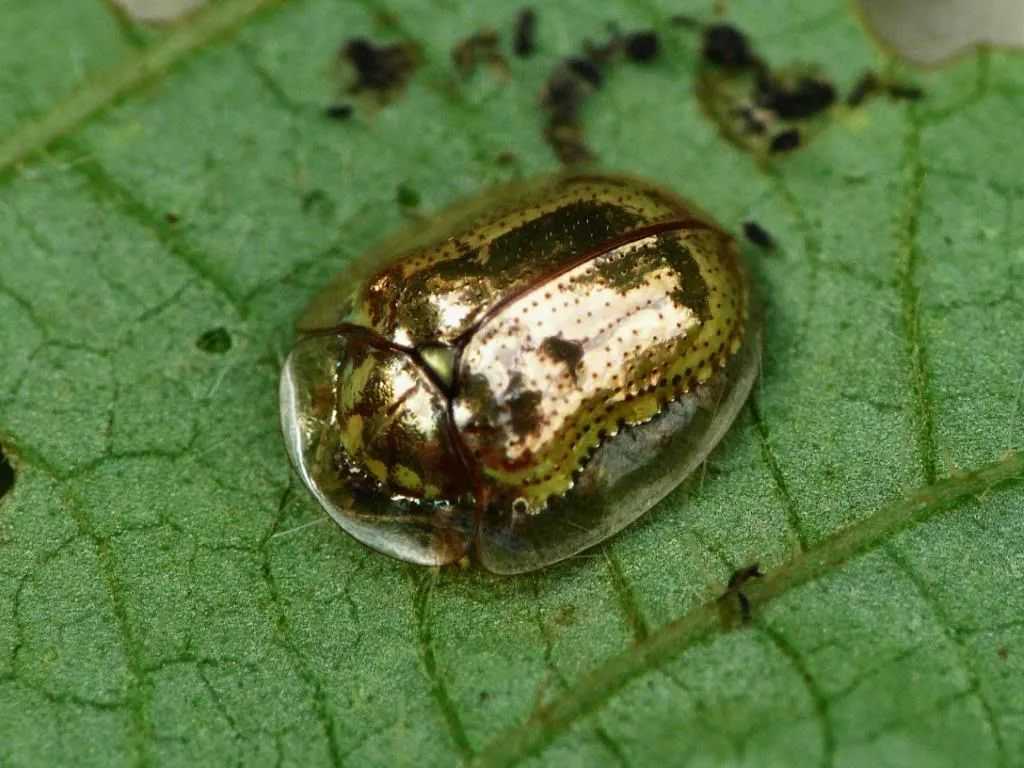
Belonging to the leaf beetle family (Chrysomelidae), the golden tortoise beetle (Charidotella sexpunctata) is a tiny arthropod renowned for its iridescent golden hue and domed, tortoise-like shell. Native to the Americas, this species boasts a remarkably wide distribution, thriving from southern Canada to South America in diverse habitats ranging from farmlands to forests.

A Living Gem: Anatomy and Adaptive Brilliance

  • Metallic Magic: The Science of Iridescence
    The beetle’s elytra (hard wing covers) display a stunning golden sheen, produced by microscopic ridges that refract light. When threatened or stressed, it can alter the moisture between these layers, temporarily turning its shell reddish-brown—a defense mechanism that startles predators. This optical trickery makes it one of nature’s most dynamic color changers among beetles.
  • Tortoise-like Design for Survival
    Growing to just 5–8 mm, its rounded, domed shape resembles a miniature tortoise, providing protection against predators. The edges of its elytra are transparent, creating a "glass-like" border that further confuses attackers. Its legs and body are pale yellow, blending seamlessly with the undersides of leaves where it feeds.

Life Cycle and Ecological Role

  • Feeding Habits and Reproduction
    The golden tortoise beetle primarily feeds on morning glory plants (Convolvulaceae), using its mandibles to scrape leaf tissue. Larvae are less glamorous—spherical and covered in spines, they carry fecal matter on their backs as a deterrent. Adults mate prolifically, laying eggs on host plants, and can undergo multiple generations per year in warm climates.
  • Invasive Potential and Natural Distribution
    While native to the Americas, its adaptability has raised concerns about potential invasions in other continents. In its natural range, it serves as prey for birds, spiders, and parasitic wasps, while also acting as a pollinator and decomposer in plant ecosystems.

Scientific Interest and Cultural Noteworthiness

Researchers study its iridescent properties to develop new materials, from optical coatings to renewable energy technologies. In popular culture, the beetle’s dazzling appearance has made it a subject of nature documentaries and educational campaigns, often celebrated as a living example of evolutionary beauty.


Despite its widespread presence, the golden tortoise beetle faces minor threats from pesticide use and habitat loss. Its resilience and adaptability, however, highlight the tenacity of small creatures in navigating human-altered landscapes—reminding us that even the tiniest jewels of nature hold secrets worth preserving

Latest Stories
Feline News2 minute readThe Oriental Longhair, a breed celebrated for its elegance and intelligence, traces its roots to mid-20th-century breeding programs aimed at expanding the color and pattern diversity of Siamese cats . Developed through crosses with breeds like Russian Blues and British Shorthairs, these cats gained recognition in the 1970s and were officially acknowledged by The International Cat Association (TICA) in 1979 and the Cat Fanciers' Association (CFA) in 1995 .
Feline News2 minute readThe Korat cat, originating from Thailand’s Nakhon Ratchasima province (formerly Korat), is a breed deeply rooted in history and cultural significance. Revered for centuries as a symbol of good luck and prosperity, these silver-blue felines have enchanted the world with their striking appearance and affectionate nature.
Feline News2 minute readA heartwarming tale of survival and companionship has thrust the Munchkin cat into the global spotlight, showcasing the breed’s unique charm and indomitable spirit. Mochi, an 8-month-old Munchkin rescued from a life-threatening illness, has become an international symbol of hope, embodying the resilience and playful nature that define these short-legged felines.
Travel News2 minute readPerched atop an 82-meter volcanic plug in Le Puy-en-Velay, France, the Chapelle Saint-Michel d’Aiguilhe stands as a testament to faith and engineering prowess. Built in 962 AD, this architectural marvel balances precariously on a basaltic rock formation, blending Romanesque austerity with Moorish-inspired ornamentation to create one of Europe’s most dramatic religious landmarks.
Feline News2 minute readRagamuffin cats, affectionately known as "muffins," have captured the hearts of cat lovers worldwide with their plush coats, docile personalities, and striking appearance. Originating in the United States in the 1990s, this breed emerged from a group of breeders seeking to expand the genetic diversity of Ragdoll cats. By crossing Ragdolls with Persians, Himalayans, and other long-haired breeds, they created a larger, more robust feline with a broader range of coat colors and patterns
Canine News2 minute readOriginating in the early 20th century, the American White Shepherd traces its lineage to the German Shepherd. Due to a recessive white coat gene, these dogs were long considered "flawed" in Germany and systematically culled from breeding programs12. However, North American breeders recognized their unique appeal and selectively developed them into a distinct breed, officially acknowledged by the United Kennel Club (UKC) in 199917
Canine News1 minute readAs the world's first operational vertical/short takeoff and landing (V/STOL) fighter jet, the British-developed Harrier, nicknamed the "Jump Jet," has left an indelible mark on aviation history through its groundbreaking design and combat prowess.