Pont-d'Arc, France: A 30,000-Year-Old Sanctuary of Prehistoric Art at Chauvet Cave


Travel News
Pont-d'Arc, France: A 30,000-Year-Old Sanctuary of Prehistoric Art at Chauvet Cave

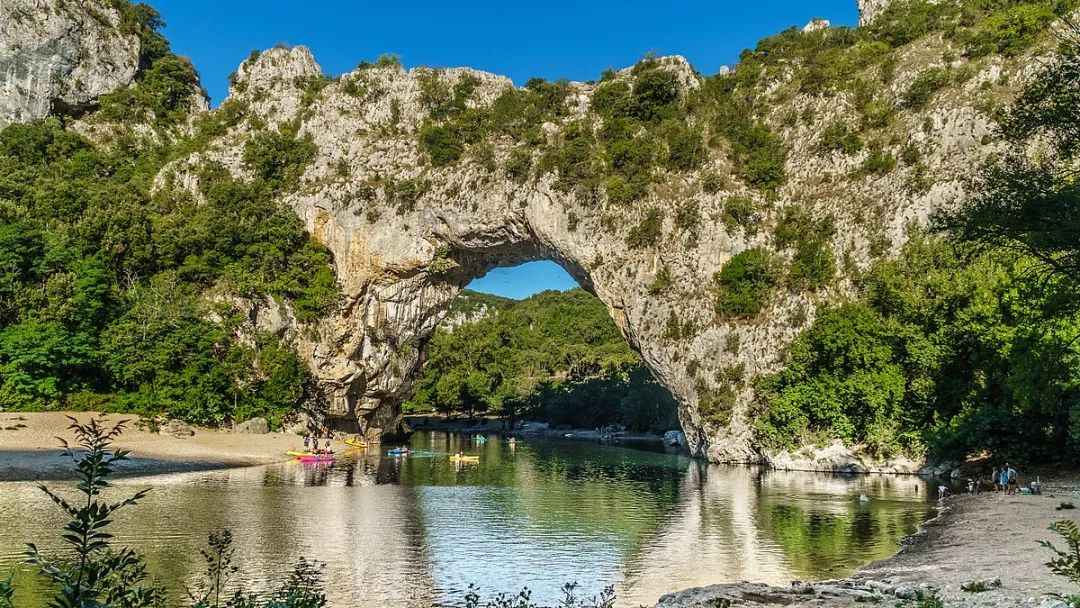
Nestled beneath the natural limestone arch of Pont-d'Arc in France's Ardèche region, the Chauvet-Pont-d'Arc Cave (Grotte Chauvet-Pont-d'Arc) stands as a UNESCO World Heritage Site and one of humanity's most profound artistic treasures. This geological marvel shelters a trove of Paleolithic masterpieces that redefine our understanding of early human creativity.


Nestled beneath the natural limestone arch of Pont-d'Arc in France's Ardèche region, the Chauvet-Pont-d'Arc Cave (Grotte Chauvet-Pont-d'Arc) stands as a UNESCO World Heritage Site and one of humanity's most profound artistic treasures. This geological marvel shelters a trove of Paleolithic masterpieces that redefine our understanding of early human creativity.

I. A Revelation: The Dawn of Artistry

On December 18, 1994, explorers Jean-Marie Chauvet, Eliette Brunel Deschamps, and Christian Hillaire uncovered an entrance sealed by rockfalls for 23,000 years. Their headlamps revealed the "Lion Panel"—a 30-foot mural depicting 13 cave lions in dynamic pursuit of bison, rendered with overlapping perspectives and lifelike musculature. Radiocarbon dating confirmed the oldest paintings, including rhinoceroses and mammoths, date back 36,000 years to the Aurignacian period—nearly twice as old as Lascaux Cave.

II. Masterpieces in Stone

The cave's 8,500 sq.m walls host over 1,000 artworks showcasing advanced techniques:


  • Anatomical precision: Woolly rhinos are shaded to appear three-dimensional
  • Natural integration: Artists used stalactite formations to contour running horses
  • Symbolic power: 425 handprints and child-sized footprints suggest ritual significance


Notably, the "Megaceros Gallery" features volcanic eruption depictions possibly documenting a 43,000-year-old event at nearby Bas-Vivarais—a testament to early humans' observational prowess.

III. Guardianship Through Innovation

To preserve the fragile environment, the original cave remains closed to the public. Only scientists in full-body suits may enter twice annually. However, a €55 million replica, Caverne du Pont-d'Arc, opened in 2015. Using 160 million laser-scanned data points and 6,000 high-res images, it recreates the cave's microclimate, including temperature, humidity, and even scent. Visitors can explore recreated chambers with 1,000 painted panels and 450 fossilized animal remains. In 2020, MIT's robotic system Scribit brought Chauvet's art into homes globally, blending ancient heritage with modern technology.

IV. A Living Dialogue

Chauvet's significance extends beyond art. Bear skulls arranged ceremonially and firepit remains hint at shamanic practices. As filmmaker Werner Herzog noted, "These paintings are not primitive scribbles but fully realized artistry—their emotional power rivals any masterpiece in history". Today, standing beneath Pont-d'Arc's natural arch, one can almost hear the whispers of Ice Age artists, their legacy enduring through time as a bridge between humanity's earliest aspirations and our modern world.
Latest Stories
Feline News2 minute readThe Oriental Longhair, a breed celebrated for its elegance and intelligence, traces its roots to mid-20th-century breeding programs aimed at expanding the color and pattern diversity of Siamese cats . Developed through crosses with breeds like Russian Blues and British Shorthairs, these cats gained recognition in the 1970s and were officially acknowledged by The International Cat Association (TICA) in 1979 and the Cat Fanciers' Association (CFA) in 1995 .
Feline News2 minute readThe Korat cat, originating from Thailand’s Nakhon Ratchasima province (formerly Korat), is a breed deeply rooted in history and cultural significance. Revered for centuries as a symbol of good luck and prosperity, these silver-blue felines have enchanted the world with their striking appearance and affectionate nature.
Feline News2 minute readA heartwarming tale of survival and companionship has thrust the Munchkin cat into the global spotlight, showcasing the breed’s unique charm and indomitable spirit. Mochi, an 8-month-old Munchkin rescued from a life-threatening illness, has become an international symbol of hope, embodying the resilience and playful nature that define these short-legged felines.
Travel News2 minute readPerched atop an 82-meter volcanic plug in Le Puy-en-Velay, France, the Chapelle Saint-Michel d’Aiguilhe stands as a testament to faith and engineering prowess. Built in 962 AD, this architectural marvel balances precariously on a basaltic rock formation, blending Romanesque austerity with Moorish-inspired ornamentation to create one of Europe’s most dramatic religious landmarks.
Feline News2 minute readRagamuffin cats, affectionately known as "muffins," have captured the hearts of cat lovers worldwide with their plush coats, docile personalities, and striking appearance. Originating in the United States in the 1990s, this breed emerged from a group of breeders seeking to expand the genetic diversity of Ragdoll cats. By crossing Ragdolls with Persians, Himalayans, and other long-haired breeds, they created a larger, more robust feline with a broader range of coat colors and patterns
Canine News2 minute readOriginating in the early 20th century, the American White Shepherd traces its lineage to the German Shepherd. Due to a recessive white coat gene, these dogs were long considered "flawed" in Germany and systematically culled from breeding programs12. However, North American breeders recognized their unique appeal and selectively developed them into a distinct breed, officially acknowledged by the United Kennel Club (UKC) in 199917
Canine News1 minute readAs the world's first operational vertical/short takeoff and landing (V/STOL) fighter jet, the British-developed Harrier, nicknamed the "Jump Jet," has left an indelible mark on aviation history through its groundbreaking design and combat prowess.