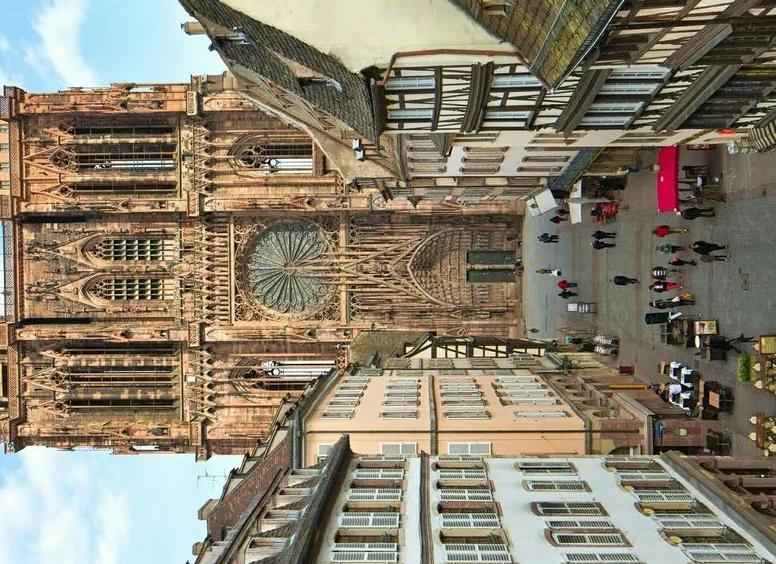
Reims Cathedral: The Spiritual Heart of French Monarchy


Travel News
Reims Cathedral: The Spiritual Heart of French Monarchy

Nestled in the Champagne region of France, the Cathédrale Notre-Dame de Reims stands as a testament to over a millennium of French history and architectural grandeur. As a UNESCO World Heritage Site, this Gothic masterpiece has been the spiritual epicenter of French royalty since Clovis I’s baptism in 496 AD, cementing its role as the ultimate symbol of monarchical legitimacy.


Source: Images from the Internet, if there is any infringement, please contact the removal of


Nestled in the Champagne region of France, the Cathédrale Notre-Dame de Reims stands as a testament to over a millennium of French history and architectural grandeur. As a UNESCO World Heritage Site, this Gothic masterpiece has been the spiritual epicenter of French royalty since Clovis I’s baptism in 496 AD, cementing its role as the ultimate symbol of monarchical legitimacy.

Architectural Splendor and Historical Layers

Begun in 1211 and completed over 250 years, the cathedral’s imposing structure—138 meters long and 38 meters high—exemplifies Gothic engineering at its finest, with flying buttresses and pointed arches soaring toward the heavens. Its façade dazzles with 2,303 sculptural figures, most famously the "Smiling Angel" whose serene expression has become an icon of Reims. Inside, the 17th-century organ with 6,800 pipes and the northern rose window depicting Genesis create a symphony of light and sound. Notably, the modernist stained glass in the Chapel of the Virgin, designed by Marc Chagall in 1974, adds a contemporary flair to the ancient edifice.

Coronations and Royal Legacy

From Henry I in 1027 to Charles X in 1825, 25 French monarchs were crowned here, their ceremonies sanctified by the 传奇 of the Holy Ampulla—a vial said to have been delivered by a dove during Clovis’ baptism, whose oil remains central to the consecration ritual. The cathedral’s history reached a crescendo with Joan of Arc: in 1429, she led Charles VII through English-held territories to secure his coronation in the unfinished nave, a pivotal moment that turned the tide of the Hundred Years’ War. This event, immortalized in stone reliefs, remains a cornerstone of French national identity.

Resilience Through Fire and War

While spared major damage during the French Revolution, the cathedral suffered near-destruction in 1914 when German artillery reduced much of it to rubble. Miraculously, its stained glass had been evacuated beforehand by the archbishop. Rebuilt over two decades with Rockefeller family funding, it reopened in 1938, a phoenix rising from the ashes. In 1945, history came full circle when the Nazi surrender was signed here, ending WWII in Europe.

A Living Monument Today

Drawing over 1.5 million visitors annually, the cathedral continues to captivate with its timeless allure. Updated visitor information for 2025, including summer hours (9:00–18:30 from June to September), ensures accessibility to modern travelers. More than a building, it is a living chronicle of France’s soul—where power, faith, and resilience converge in stone and glass.

Latest Stories
Travel News1 minute readA climate specialist stated that the May just concluded ranks as the second warmest May globally since meteorological record-keeping began. Over the past month, temperatures across Europe surged sharply from below-average levels to fuel one of the continent’s most ferocious heatwaves. This year’s heatwave arrived earlier than any previously documented, shattering dozens of May temperature benchmarks, with France, the United Kingdom, Ireland and Portugal bearing the brunt of the extreme heat.
Feline News1 minute readMinuet cats, also known as Napoleon cats, are a delightful and relatively new feline breed that have been winning the hearts of cat lovers around the world with their adorable appearance and friendly personalities.
Feline News1 minute readThe Balinese cat, also known as the Bali cat or Java cat, is a charming medium - sized long - haired cat. It originated in the United States and is a long - haired mutant of the Siamese cat. It is named the Balinese cat because its movements are 酷似 those of the native Balinese dancers.
Feline News2 minute readThe Exotic Shorthair, often dubbed the "lazy man’s Persian," has solidified its status as one of the most beloved cat breeds globally, blending the elegance of Persians with the low-maintenance charm of American Shorthairs. Developed in the 1960s by American breeders aiming to create a short-haired Persian variant, this breed has since captivated cat lovers with its round face, plush coat, and laid-back demeanor 28.
Travel News2 minute readNestled along the cliffs of the French Riviera (Côte d'Azur), the Trois Corniches de Nice—three coastal roads ascending from sea level to mountain heights—offer some of Europe’s most dramatic views. Stretching eastward from Nice, the Lower Corniche (Corniche Inférieure), Middle Corniche (Moyenne Corniche), and Upper Corniche (Grande Corniche) each provide a unique perspective of the Mediterranean, making them a pilgrimage for road-trippers and photographers alike.
Travel News2 minute readThe soul of Colmar lies in its half-timbered houses, dating back to the 16th century. These whimsical structures feature exposed wooden frames in geometric patterns, their facades painted in vibrant hues like buttercup yellow and sky blue. Flower-boxed windows and playful figurines adorn the facades, while their reflections dance on the Lauch River, creating the iconic Petite Venise (Little Venice) district. Here, fishermen pilot flower-decked boats, and riverside bistros serve Alsatian specialties like choucroute garnie, evoking scenes from Hayao Miyazaki’s Howl’s Moving Castle.
Feline News2 minute readThe Oriental Longhair, a breed celebrated for its elegance and intelligence, traces its roots to mid-20th-century breeding programs aimed at expanding the color and pattern diversity of Siamese cats . Developed through crosses with breeds like Russian Blues and British Shorthairs, these cats gained recognition in the 1970s and were officially acknowledged by The International Cat Association (TICA) in 1979 and the Cat Fanciers' Association (CFA) in 1995 .