Rhynchopelates oxyrhynchus: The Sharpbeak Terapon of Asian Coastal Seas


Marine Biology
Rhynchopelates oxyrhynchus: The Sharpbeak Terapon of Asian Coastal Seas

Rhynchopelates oxyrhynchus, commonly known as the sharpbeak terapon, is a captivating species within the Terapontidae family, inhabiting the coastal waters of Asia. This ray - finned fish is celebrated for its unique appearance and ecological role in the diverse ecosystems of the Western Pacific.


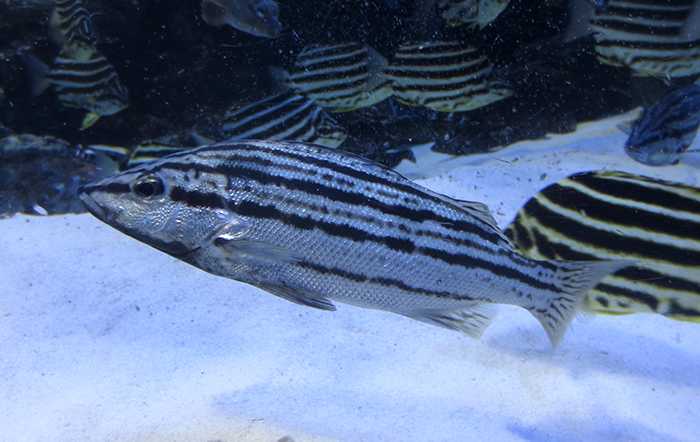
Growing up to 25 centimeters in length, the sharpbeak terapon features an oblong, relatively deep, and laterally compressed body, with juveniles showing more pronounced lateral compression. Its small, slightly oblique mouth does not extend as far back as the eye. The teeth are villiform, arranged in bands in each jaw, with the outer row being significantly larger than the inner rows, and there are no teeth on the roof of the mouth. The body is grey on the back and silvery below, adorned with four rather blotchy dark brown or black longitudinal stripes along its length, and some specimens even have irregular stripes between these main stripes. The base of the spiny part of the dorsal fin is dusky, as is its margin, while the soft - rayed part is banded. Juveniles have clear caudal fin lobes, but in adults, several narrow, irregular, parallel stripes appear on each lobe. The dorsal fin contains 12 spines and 9 - 11 soft rays, with the spiny part arched, and the third to sixth spines being the longest. The anal fin has 3 spines and 7 - 9 soft rays, and there are 60 - 75 pored scales in the lateral line.


Native to the Western Pacific, this species ranges from southern Japan and Taiwan to southern China and the Philippines. It inhabits inshore waters, frequently venturing into brackish waters, and juveniles are known to enter freshwater. As a carnivorous fish, it preys on invertebrates and smaller fishes. After spawning, the males take on the responsibility of guarding the eggs, fanning them to ensure proper oxygenation.


The sharpbeak terapon plays a crucial role in the coastal food web, both as a predator controlling populations of smaller organisms and as prey for larger marine species. It is fished using traps, handlines, and other inshore fishing gear. In Japan, it is also commercially aquacultured. However, like many coastal species, it faces threats from habitat degradation due to coastal development, pollution, and overfishing. Conservation efforts, such as protecting estuarine and coastal habitats and implementing sustainable fishing practices, are essential to ensure the long - term survival of this remarkable fish and the integrity of the ecosystems it inhabits.

Latest Stories
Feline News2 minute readThe Oriental Longhair, a breed celebrated for its elegance and intelligence, traces its roots to mid-20th-century breeding programs aimed at expanding the color and pattern diversity of Siamese cats . Developed through crosses with breeds like Russian Blues and British Shorthairs, these cats gained recognition in the 1970s and were officially acknowledged by The International Cat Association (TICA) in 1979 and the Cat Fanciers' Association (CFA) in 1995 .
Feline News2 minute readThe Korat cat, originating from Thailand’s Nakhon Ratchasima province (formerly Korat), is a breed deeply rooted in history and cultural significance. Revered for centuries as a symbol of good luck and prosperity, these silver-blue felines have enchanted the world with their striking appearance and affectionate nature.
Feline News2 minute readA heartwarming tale of survival and companionship has thrust the Munchkin cat into the global spotlight, showcasing the breed’s unique charm and indomitable spirit. Mochi, an 8-month-old Munchkin rescued from a life-threatening illness, has become an international symbol of hope, embodying the resilience and playful nature that define these short-legged felines.
Travel News2 minute readPerched atop an 82-meter volcanic plug in Le Puy-en-Velay, France, the Chapelle Saint-Michel d’Aiguilhe stands as a testament to faith and engineering prowess. Built in 962 AD, this architectural marvel balances precariously on a basaltic rock formation, blending Romanesque austerity with Moorish-inspired ornamentation to create one of Europe’s most dramatic religious landmarks.
Feline News2 minute readRagamuffin cats, affectionately known as "muffins," have captured the hearts of cat lovers worldwide with their plush coats, docile personalities, and striking appearance. Originating in the United States in the 1990s, this breed emerged from a group of breeders seeking to expand the genetic diversity of Ragdoll cats. By crossing Ragdolls with Persians, Himalayans, and other long-haired breeds, they created a larger, more robust feline with a broader range of coat colors and patterns
Canine News2 minute readOriginating in the early 20th century, the American White Shepherd traces its lineage to the German Shepherd. Due to a recessive white coat gene, these dogs were long considered "flawed" in Germany and systematically culled from breeding programs12. However, North American breeders recognized their unique appeal and selectively developed them into a distinct breed, officially acknowledged by the United Kennel Club (UKC) in 199917
Canine News1 minute readAs the world's first operational vertical/short takeoff and landing (V/STOL) fighter jet, the British-developed Harrier, nicknamed the "Jump Jet," has left an indelible mark on aviation history through its groundbreaking design and combat prowess.