Scorpionflies: The Insects with a Deceptive 'Scorpion Tail'


Insect Information
Scorpionflies: The Insects with a Deceptive 'Scorpion Tail'

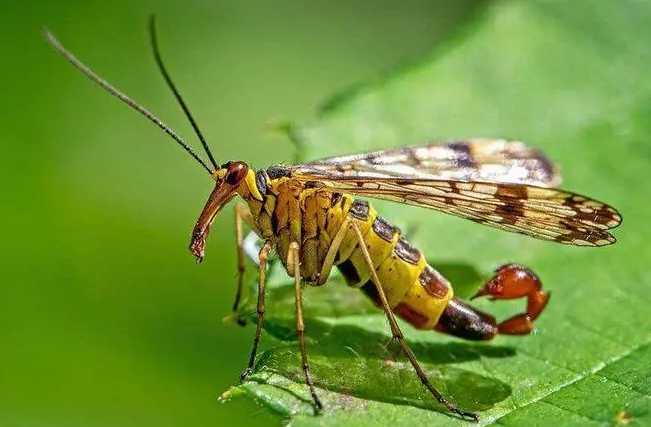
In forests and meadows worldwide, scorpionflies (order Mecoptera) perplex onlookers with a curious feature: a tail that resembles a scorpion’s stinger, but serves an entirely different purpose. Contrary to appearances, this bulbous, curved appendage at the insect’s rear is not a venomous weapon—but rather the male’s elaborate genitalia, a bizarre evolutionary trait that has fascinated entomologists for centuries.


A Misleading Appendage: Form vs. Function
The male scorpionfly’s "tail" is actually an enlarged, segmented abdomen modified into a clasping organ used during mating. Resembling a scorpion’s stinger in shape and positioning, it can curl upward in a threatening pose, yet lacks any venom glands or piercing ability. This mimicry is thought to deter predators, as the illusion of a scorpion’s sting may dissuade birds or small mammals from attacking. Females, meanwhile, have straight, unspecialized abdomens, highlighting the dramatic sexual dimorphism in the species. Despite their intimidating appearance, scorpionflies are harmless to humans, feeding primarily on decaying plant matter, small insects, and even carrion.


Behavior and Evolutionary Significance
Scorpionflies are named for their scorpion-like tail and fly-like wings, which fold over their bodies at rest. During courtship, males use their genitalic "tail" to grasp females, while some species offer nuptial gifts of saliva or prey to attract mates—a behavior rare in insects. Their unique morphology provides insights into evolutionary biology, as the scorpion tail mimicry exemplifies how sexual selection and predator avoidance can shape bizarre traits. Found in temperate regions, they play a role in ecosystems as decomposers and pollinators, though their secretive nature makes them easy to overlook.


For researchers, scorpionflies serve as a reminder that nature’s designs often prioritize survival and reproduction over straightforward functionality. Their deceptive "stinger" proves that in the insect world, even the most fearsome-looking features may hide a surprising purpose. As these quirky insects flutter through the underbrush, their existence challenges our assumptions—showing that sometimes, the most intimidating appendages are anything but weapons.
Latest Stories
Travel News2 minute readNestled in the French Pre-Alps, the Plateau du Vercors stands as a testament to nature’s raw power and humanity’s indomitable spirit. Rising abruptly from the valleys of Isère, this limestone plateau—dominated by peaks like Grand Veymont (2,346 meters)—features sheer cliffs and labyrinthine gorges that earned it the nickname "the Natural Great Wall". Its dramatic landscapes, shaped over millennia by erosion, have not only sculpted a geological marvel but also forged a theater of historical significance.
Cultural News1 minute readSpain’s tomato-throwing "La Tomatina" is wildly popular, but for those who prefer hurling something tangier, head to Italy in February. At the Ivrea Carnival, thousands of ripe oranges are pelted in a juicy battle during the festival’s highlight.
Cultural News1 minute readIn Wuppertal, Germany, there’s a pedestrian bridge that looks like it’s built from giant Lego bricks. Though it’s actually a concrete structure, artists have painted it to mimic the iconic toy blocks, creating a playful optical illusion.
Feline News2 minute readThe European Burmese cat, a breed born from careful crossbreeding in mid-20th century Europe, has captivated cat enthusiasts with its elegant physique and affectionate nature. Originating from the American Burmese stock imported to the UK, European breeders sought to diversify the gene pool by introducing Siamese and British Shorthair bloodlines, resulting in a distinct feline with refined features. Recognized by major associations like the CFA since 2002, this breed stands out for its sleek, muscular build and striking golden or amber almond-shaped eyes, which contrast sharply with the rounde
Feline News2 minute readIn recent years, the Scottish Fold cat has become an internet sensation, celebrated for its distinctive folded ears and owl-like appearance. However, behind the adorable facade lies a dark reality rooted in genetic abnormality and ethical debate. This breed, born from a spontaneous mutation in a Scottish barn cat named Susie in 1961, has sparked global controversy over its health implications and breeding practices.
Feline News1 minute readOriginating from a spontaneous genetic mutation in 1950, the Cornish Rex emerged in Cornwall, England, when a cream-colored kitten named Kallibunker was born with a dense, wavy coat resembling a lamb’s fleece1. Recognizing its uniqueness, owner Nina Ennismore collaborated with geneticists to establish the breed. Due to the recessive nature of the mutation, breeding two Cornish Rex cats guarantees curly-coated offspring13.
Health News1 minute readOn June 30, FBI Deputy Director Dan Bongino announced the dismantling of the largest healthcare fraud case in U.S. history, with revised to $14.6 billion. The investigation covered all 50 federal districts, indicting 324 individuals—including 96 medical practitioners—and seizing $245 million in assets.