The Armor-Plated Scaly-Foot Snail: Deep-Sea Marvel of the Indian Ocean


Marine Biology
The Armor-Plated Scaly-Foot Snail: Deep-Sea Marvel of the Indian Ocean

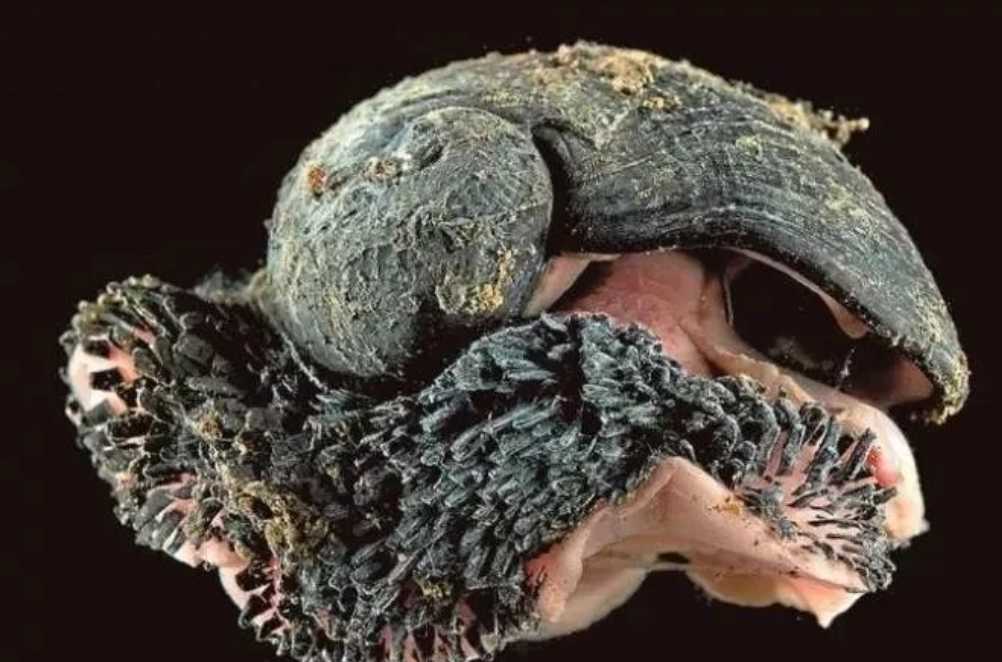
Living near hydrothermal vents in the Indian Ocean, the scaly-foot snail (Chrysomallon squamiferum) defies survival norms with its iron-clad armor and ability to withstand 350°C temperatures. This extraordinary gastropod, discovered in 2001 near the Kairei hydrothermal field, boasts a three-layered shell infused with iron sulfides, making it one of the few animals on Earth to incorporate metal into its exoskeleton. Its survival hinges on a tiny habitat—just two football fields in size—where it thrives in a world devoid of sunlight, relying on bacterial symbiosis for nutrition.


Anatomy of a Deep-Sea Warrior

The snail’s most remarkable feature is its composite shell:


  1. Outer Layer: A thin, iron sulfide coating that forms sharp scales, deterring predators like crabs.
  2. Middle Layer: A porous organic matrix that absorbs impact, similar to Kevlar.
  3. Inner Layer: A calcium carbonate shell for structural support.


This armor isn’t just defensive; it’s a product of its extreme environment. Seawater superheated by vents dissolves minerals, which the snail’s tissues convert into iron sulfides. Even its foot is armored, with iron-rich scales protecting it from scalding fluids.


Nutritionally, the snail is a biological oddity. Instead of eating, it harbors γ-Proteobacteria in its gills, which convert hydrogen sulfide from vents into energy via chemosynthesis. This symbiosis eliminates the need for traditional feeding, allowing it to thrive in an ecosystem where organic matter is scarce.

Vulnerability in a Fragile Paradise

Restricted to only a few Indian Ocean vent fields, the scaly-foot snail faces existential threats. Deep-sea mining for rare minerals has already destroyed parts of its habitat, and exploratory drills risk disrupting the delicate chemistry of hydrothermal vents. Unlike most snails, it has a low reproductive rate, laying fewer than 100 eggs annually, which compounds its vulnerability to population loss.


In 2019, the IUCN classified it as "Endangered," highlighting the urgency of protecting its tiny range. Scientists argue that vent ecosystems like these hold keys to understanding life’s origins and potential extraterrestrial habitats. For the scaly-foot snail, survival isn’t just about its own future—it’s a battle to preserve one of Earth’s last frontiers of biological innovation.


In the pitch-black depths where no sunlight reaches, this armored mollusk stands as a testament to nature’s ability to craft life in the most inhospitable places. Its existence reminds humanity that even in the ocean’s darkest corners, marvels of evolution await—if we choose to protect them
Latest Stories
Feline News2 minute readThe Oriental Longhair, a breed celebrated for its elegance and intelligence, traces its roots to mid-20th-century breeding programs aimed at expanding the color and pattern diversity of Siamese cats . Developed through crosses with breeds like Russian Blues and British Shorthairs, these cats gained recognition in the 1970s and were officially acknowledged by The International Cat Association (TICA) in 1979 and the Cat Fanciers' Association (CFA) in 1995 .
Feline News2 minute readThe Korat cat, originating from Thailand’s Nakhon Ratchasima province (formerly Korat), is a breed deeply rooted in history and cultural significance. Revered for centuries as a symbol of good luck and prosperity, these silver-blue felines have enchanted the world with their striking appearance and affectionate nature.
Feline News2 minute readA heartwarming tale of survival and companionship has thrust the Munchkin cat into the global spotlight, showcasing the breed’s unique charm and indomitable spirit. Mochi, an 8-month-old Munchkin rescued from a life-threatening illness, has become an international symbol of hope, embodying the resilience and playful nature that define these short-legged felines.
Travel News2 minute readPerched atop an 82-meter volcanic plug in Le Puy-en-Velay, France, the Chapelle Saint-Michel d’Aiguilhe stands as a testament to faith and engineering prowess. Built in 962 AD, this architectural marvel balances precariously on a basaltic rock formation, blending Romanesque austerity with Moorish-inspired ornamentation to create one of Europe’s most dramatic religious landmarks.
Feline News2 minute readRagamuffin cats, affectionately known as "muffins," have captured the hearts of cat lovers worldwide with their plush coats, docile personalities, and striking appearance. Originating in the United States in the 1990s, this breed emerged from a group of breeders seeking to expand the genetic diversity of Ragdoll cats. By crossing Ragdolls with Persians, Himalayans, and other long-haired breeds, they created a larger, more robust feline with a broader range of coat colors and patterns
Canine News2 minute readOriginating in the early 20th century, the American White Shepherd traces its lineage to the German Shepherd. Due to a recessive white coat gene, these dogs were long considered "flawed" in Germany and systematically culled from breeding programs12. However, North American breeders recognized their unique appeal and selectively developed them into a distinct breed, officially acknowledged by the United Kennel Club (UKC) in 199917
Canine News1 minute readAs the world's first operational vertical/short takeoff and landing (V/STOL) fighter jet, the British-developed Harrier, nicknamed the "Jump Jet," has left an indelible mark on aviation history through its groundbreaking design and combat prowess.