The Yeti Crab: Deep-Sea Marvel Renowned for Its Golden-Haired Legs


Insect Information
The Yeti Crab: Deep-Sea Marvel Renowned for Its Golden-Haired Legs

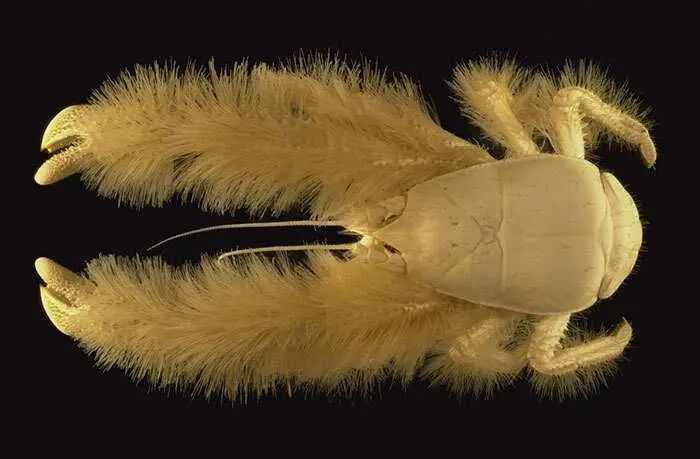
Also known as the Hoff crab, the yeti crab (Kiwa hirsuta) has captivated marine biologists with its most striking feature: legs and claws entirely covered in dense, golden bristles. Discovered in 2005 near hydrothermal vents in the South Pacific, this crustacean belongs to the family Kiwidae and thrives in some of the ocean’s most extreme environments.


Anatomy and Adaptations for Life in the Abyss

  • Golden Bristles as a Survival Tool
    The crab’s hairy appendages are not fur but specialized setae (bristles) that host symbiotic bacteria. These bacteria convert toxic chemicals from hydrothermal vents—such as hydrogen sulfide—into energy through chemosynthesis, forming the base of the crab’s food chain. The golden color may result from mineral deposits on the setae, providing both protection and a surface for bacterial growth.
  • Blind and Bald in the Dark
    Lacking functional eyes, the yeti crab relies on sensory hairs to navigate the pitch-black depths. Its flattened body and strong claws allow it to cling to vent chimneys, while its feathery gills extract oxygen from superheated, mineral-rich water. Growing up to 15 centimeters, it is one of the few animals capable of surviving near 400°C vent plumes.

Ecology and Behavior in Hydrothermal Ecosystems

  • A Unique Symbiotic Relationship
    The crab actively tends to its bacterial gardens, waving its legs to circulate nutrient-rich water and grooming the setae to remove debris. In return, it feeds on the bacteria, making it a rare example of a crustacean relying primarily on chemosynthesis rather than predation or scavenging.
  • Reproduction and Distribution
    Females carry eggs beneath their abdomens, protecting them from toxic vent fluids. The species has been found in multiple vent fields, including the East Scotia Ridge and the Mariana Trench, though its exact distribution remains unclear due to the inaccessibility of its habitat.

Scientific Significance and Conservation

The yeti crab’s discovery revolutionized understanding of deep-sea ecosystems, proving life can thrive in environments once thought uninhabitable. Its symbiotic relationship with bacteria offers insights into astrobiology, inspiring theories about life on other planets with extreme conditions.


While not currently endangered, the species faces potential threats from deep-sea mining, which could destroy hydrothermal vent habitats. Scientists advocate for the establishment of marine protected areas around vent fields, highlighting the need to preserve these unique ecosystems before their secrets are lost.


In the pitch-black depths where sunlight never reaches, the yeti crab stands as a testament to nature’s ability to craft life in the most unlikely places. Its golden-haired form, glowing in the submarine darkness, reminds humanity that the ocean’s mysteries are far from fully explored—and that every discovery holds lessons for understanding the limits of life itself.
Latest Stories
Feline News2 minute readThe Oriental Longhair, a breed celebrated for its elegance and intelligence, traces its roots to mid-20th-century breeding programs aimed at expanding the color and pattern diversity of Siamese cats . Developed through crosses with breeds like Russian Blues and British Shorthairs, these cats gained recognition in the 1970s and were officially acknowledged by The International Cat Association (TICA) in 1979 and the Cat Fanciers' Association (CFA) in 1995 .
Feline News2 minute readThe Korat cat, originating from Thailand’s Nakhon Ratchasima province (formerly Korat), is a breed deeply rooted in history and cultural significance. Revered for centuries as a symbol of good luck and prosperity, these silver-blue felines have enchanted the world with their striking appearance and affectionate nature.
Feline News2 minute readA heartwarming tale of survival and companionship has thrust the Munchkin cat into the global spotlight, showcasing the breed’s unique charm and indomitable spirit. Mochi, an 8-month-old Munchkin rescued from a life-threatening illness, has become an international symbol of hope, embodying the resilience and playful nature that define these short-legged felines.
Travel News2 minute readPerched atop an 82-meter volcanic plug in Le Puy-en-Velay, France, the Chapelle Saint-Michel d’Aiguilhe stands as a testament to faith and engineering prowess. Built in 962 AD, this architectural marvel balances precariously on a basaltic rock formation, blending Romanesque austerity with Moorish-inspired ornamentation to create one of Europe’s most dramatic religious landmarks.
Feline News2 minute readRagamuffin cats, affectionately known as "muffins," have captured the hearts of cat lovers worldwide with their plush coats, docile personalities, and striking appearance. Originating in the United States in the 1990s, this breed emerged from a group of breeders seeking to expand the genetic diversity of Ragdoll cats. By crossing Ragdolls with Persians, Himalayans, and other long-haired breeds, they created a larger, more robust feline with a broader range of coat colors and patterns
Canine News2 minute readOriginating in the early 20th century, the American White Shepherd traces its lineage to the German Shepherd. Due to a recessive white coat gene, these dogs were long considered "flawed" in Germany and systematically culled from breeding programs12. However, North American breeders recognized their unique appeal and selectively developed them into a distinct breed, officially acknowledged by the United Kennel Club (UKC) in 199917
Canine News1 minute readAs the world's first operational vertical/short takeoff and landing (V/STOL) fighter jet, the British-developed Harrier, nicknamed the "Jump Jet," has left an indelible mark on aviation history through its groundbreaking design and combat prowess.