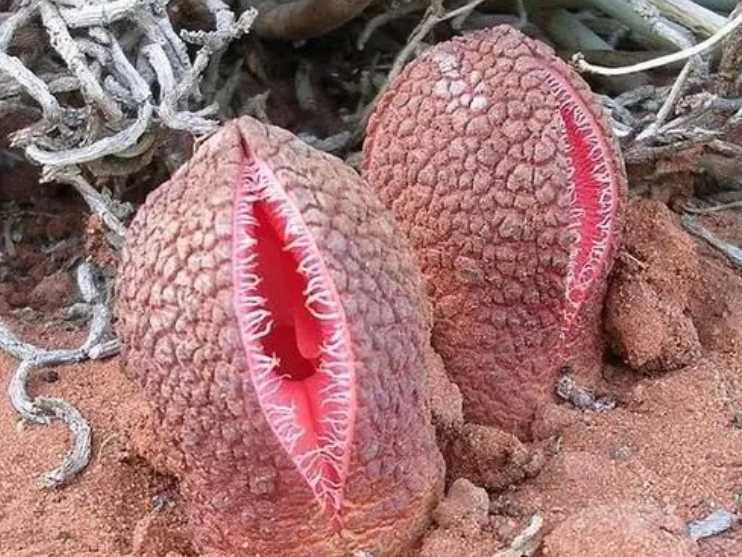
The Bizarre African Hydnora: A Desert Enigma


Plant Information
The Bizarre African Hydnora: A Desert Enigma

In the arid and inhospitable deserts of southern Africa, a truly extraordinary plant lurks beneath the sandy surface, emerging only to reveal its peculiar and captivating form - the African Hydnora, or Hydnora africana. This unique plant has long intrigued botanists, nature enthusiasts, and even passers - by lucky (or perhaps unlucky) enough to encounter its strange presence.

The African Hydnora is a parasitic plant, spending most of its life hidden from view. Its vegetative parts, entirely lacking in chlorophyll and leaves, resemble a fungus more than a typical plant. The plant's body consists mainly of a network of thick rhizophores - subterranean stems and roots that spread through the soil around its host plant. These fleshy, angular, and warty stems bear outgrowths similar to worms, which attach to the roots of the host, usually species of the genus Euphorbia such as E. mauritanica and E. tirucalli. It's only when the developing flowers push through the ground that the plant becomes visible.


The flowers of the African Hydnora are a sight to behold, albeit a rather unusual one. The buds develop underground and eventually emerge, reaching a height of about 100 to 150 mm. The spherical flower is brown on the outside, but its inner surface is a bright salmon to orange color. It has 3 or 4 thick, fleshy perianth lobes. Initially fused, these lobes rupture vertically as the flower matures, exposing the inner structures. The inner surface of the perianth lobes is covered in stout bristles, and the stamens are located halfway down the 10 - 20 mm wide perianth tube. What makes these flowers even more remarkable is their odor. They emit a putrid smell, similar to that of rotting meat, which is a key part of their survival strategy. This foul odor attracts carrion beetles and other insects. Once inside the flower, the insects are temporarily trapped by the bristles. As they struggle to escape, they brush against the anthers, picking up pollen, and then deposit it on the stigma as they continue to move around, thus pollinating the flower.


Despite its somewhat macabre appearance and smell, the African Hydnora has cultural and ecological significance. In some African cultures, the fruit of the plant is valued. The fruit is a sub - globose, underground berry with a thick, leathery skin. The seeds are numerous and small, embedded in a gelatinous, edible fleshy pulp that is rich in starch. Local people, as well as animals like porcupines, moles, baboons, and jackals, enjoy the fruit. In fact, the fruit is so liked by certain animals that they help in the plant's seed dispersal. After being eaten, the seeds pass through the animals' digestive systems unharmed and are deposited in new locations, allowing the African Hydnora to spread.

Latest Stories
Feline News2 minute readThe Oriental Longhair, a breed celebrated for its elegance and intelligence, traces its roots to mid-20th-century breeding programs aimed at expanding the color and pattern diversity of Siamese cats . Developed through crosses with breeds like Russian Blues and British Shorthairs, these cats gained recognition in the 1970s and were officially acknowledged by The International Cat Association (TICA) in 1979 and the Cat Fanciers' Association (CFA) in 1995 .
Feline News2 minute readThe Korat cat, originating from Thailand’s Nakhon Ratchasima province (formerly Korat), is a breed deeply rooted in history and cultural significance. Revered for centuries as a symbol of good luck and prosperity, these silver-blue felines have enchanted the world with their striking appearance and affectionate nature.
Feline News2 minute readA heartwarming tale of survival and companionship has thrust the Munchkin cat into the global spotlight, showcasing the breed’s unique charm and indomitable spirit. Mochi, an 8-month-old Munchkin rescued from a life-threatening illness, has become an international symbol of hope, embodying the resilience and playful nature that define these short-legged felines.
Travel News2 minute readPerched atop an 82-meter volcanic plug in Le Puy-en-Velay, France, the Chapelle Saint-Michel d’Aiguilhe stands as a testament to faith and engineering prowess. Built in 962 AD, this architectural marvel balances precariously on a basaltic rock formation, blending Romanesque austerity with Moorish-inspired ornamentation to create one of Europe’s most dramatic religious landmarks.
Feline News2 minute readRagamuffin cats, affectionately known as "muffins," have captured the hearts of cat lovers worldwide with their plush coats, docile personalities, and striking appearance. Originating in the United States in the 1990s, this breed emerged from a group of breeders seeking to expand the genetic diversity of Ragdoll cats. By crossing Ragdolls with Persians, Himalayans, and other long-haired breeds, they created a larger, more robust feline with a broader range of coat colors and patterns
Canine News2 minute readOriginating in the early 20th century, the American White Shepherd traces its lineage to the German Shepherd. Due to a recessive white coat gene, these dogs were long considered "flawed" in Germany and systematically culled from breeding programs12. However, North American breeders recognized their unique appeal and selectively developed them into a distinct breed, officially acknowledged by the United Kennel Club (UKC) in 199917
Canine News1 minute readAs the world's first operational vertical/short takeoff and landing (V/STOL) fighter jet, the British-developed Harrier, nicknamed the "Jump Jet," has left an indelible mark on aviation history through its groundbreaking design and combat prowess.