The Bubble Alga: Nature’s Giant Single-Celled Marvel Floating in Tropical Seas


Marine Biology
The Bubble Alga: Nature’s Giant Single-Celled Marvel Floating in Tropical Seas

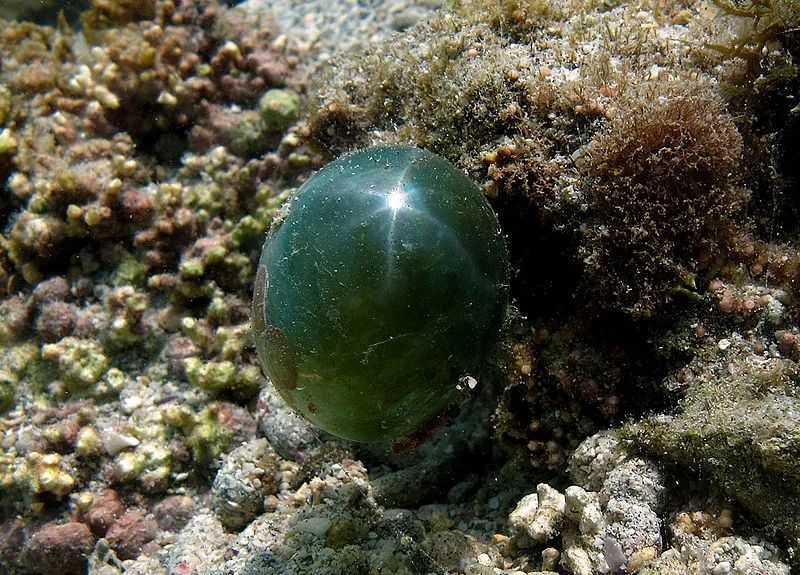
Known as the "bubble alga" or "sailor’s eyeball," Valonia ventricosa is a remarkable marine alga and one of the largest single-celled organisms on Earth. Thriving in tropical and subtropical oceans, this spherical green alga has fascinated biologists for its unique structure—each "bubble" is a single cell that can grow up to 5 centimeters in diameter, defying conventional notions of cellular size.


A Single Cell as a Living Sphere: Anatomy and Adaptations

  • Giant Unicellular Wonder
    Unlike most single cells visible only under a microscope, Valonia ventricosa forms hollow, rubbery spheres with a bright green chloroplast-laden cytoplasm lining the cell wall. The interior is filled with a watery sap, maintaining turgor pressure to sustain the bubble’s shape. This extraordinary size is achieved through nuclear division without cell division, resulting in a coenocytic structure (multiple nuclei within a single cell membrane).
  • Photosynthetic Strategy
    Living in shallow, sunlit waters, the alga uses chlorophyll to perform photosynthesis, converting sunlight into energy. Its spherical shape maximizes light absorption, while the thick cell wall protects it from herbivores like sea urchins and fish. When disturbed, the bubbles may release a sticky mucilage, deterring predators.

Ecology and Life in the Coral Reefs

  • Habitat and Distribution
    Found in clear, warm waters from the Indian Ocean to the Caribbean, Valonia ventricosa attaches to reefs, rocks, or seagrass beds using fine rhizoids (root-like structures). It prefers areas with moderate wave action, which provides nutrients and prevents sediment buildup.
  • Role in Marine Ecosystems
    As a primary producer, the bubble alga contributes to oxygen production and serves as a habitat for tiny invertebrates seeking shelter within its folds. Its decomposing cells release nutrients into the water, supporting coral reef health. However, under certain conditions (e.g., nutrient runoff), it can form dense mats, outcompeting other algae and disrupting local ecosystems.

Scientific Significance and Human Interaction
  • Cell Biology in the Extreme
    Valonia ventricosa is a model organism for studying cell physiology, as its large size allows researchers to easily manipulate and observe cellular processes. Studies on its membrane transport and osmotic regulation have shed light on how single cells maintain homeostasis.
  • Marine Ornament and Conservation
    In the aquarium trade, bubble algae are prized for their unique appearance but require careful maintenance to prevent overgrowth. In the wild, they face threats from coral bleaching, ocean acidification, and human disturbance. Their presence in a reef is often an indicator of water quality, making them valuable ecological sentinels.


With its spherical form floating in sunlit seas, Valonia ventricosa challenges our understanding of life at the cellular level. This "sailor’s eyeball" reminds us that in nature, even the simplest forms can achieve extraordinary feats—proving that size and complexity are not always synonymous, and that a single cell can hold the beauty and resilience of an entire organism.
Latest Stories
Travel News1 minute readA climate specialist stated that the May just concluded ranks as the second warmest May globally since meteorological record-keeping began. Over the past month, temperatures across Europe surged sharply from below-average levels to fuel one of the continent’s most ferocious heatwaves. This year’s heatwave arrived earlier than any previously documented, shattering dozens of May temperature benchmarks, with France, the United Kingdom, Ireland and Portugal bearing the brunt of the extreme heat.
Feline News1 minute readMinuet cats, also known as Napoleon cats, are a delightful and relatively new feline breed that have been winning the hearts of cat lovers around the world with their adorable appearance and friendly personalities.
Feline News1 minute readThe Balinese cat, also known as the Bali cat or Java cat, is a charming medium - sized long - haired cat. It originated in the United States and is a long - haired mutant of the Siamese cat. It is named the Balinese cat because its movements are 酷似 those of the native Balinese dancers.
Feline News2 minute readThe Exotic Shorthair, often dubbed the "lazy man’s Persian," has solidified its status as one of the most beloved cat breeds globally, blending the elegance of Persians with the low-maintenance charm of American Shorthairs. Developed in the 1960s by American breeders aiming to create a short-haired Persian variant, this breed has since captivated cat lovers with its round face, plush coat, and laid-back demeanor 28.
Travel News2 minute readNestled along the cliffs of the French Riviera (Côte d'Azur), the Trois Corniches de Nice—three coastal roads ascending from sea level to mountain heights—offer some of Europe’s most dramatic views. Stretching eastward from Nice, the Lower Corniche (Corniche Inférieure), Middle Corniche (Moyenne Corniche), and Upper Corniche (Grande Corniche) each provide a unique perspective of the Mediterranean, making them a pilgrimage for road-trippers and photographers alike.
Travel News2 minute readThe soul of Colmar lies in its half-timbered houses, dating back to the 16th century. These whimsical structures feature exposed wooden frames in geometric patterns, their facades painted in vibrant hues like buttercup yellow and sky blue. Flower-boxed windows and playful figurines adorn the facades, while their reflections dance on the Lauch River, creating the iconic Petite Venise (Little Venice) district. Here, fishermen pilot flower-decked boats, and riverside bistros serve Alsatian specialties like choucroute garnie, evoking scenes from Hayao Miyazaki’s Howl’s Moving Castle.
Feline News2 minute readThe Oriental Longhair, a breed celebrated for its elegance and intelligence, traces its roots to mid-20th-century breeding programs aimed at expanding the color and pattern diversity of Siamese cats . Developed through crosses with breeds like Russian Blues and British Shorthairs, these cats gained recognition in the 1970s and were officially acknowledged by The International Cat Association (TICA) in 1979 and the Cat Fanciers' Association (CFA) in 1995 .