The Galapagos Walking Fish: A Species That 'Walks' on the Ocean Floor Instead of Swimming


Marine Biology
The Galapagos Walking Fish: A Species That 'Walks' on the Ocean Floor Instead of Swimming

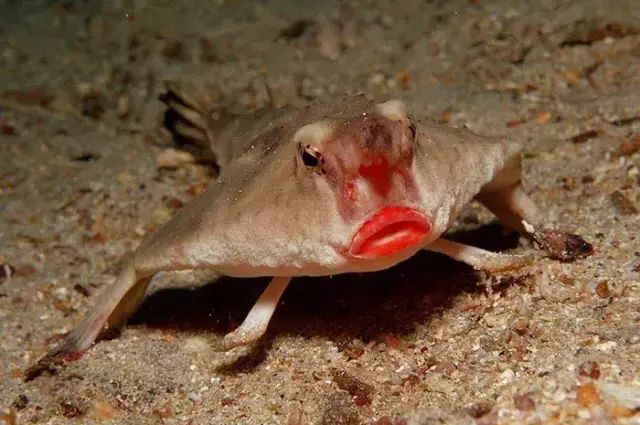
Discovered in the diverse marine ecosystems of the Galapagos Islands, a unique fish species has astonished scientists with its unconventional locomotion: rather than swimming, it "walks" along the ocean floor using modified pectoral fins. This extraordinary creature, known as the red-lipped batfish (Ogcocephalus darwini), exemplifies the bizarre adaptations that evolve in isolated environments like the Galapagos.


From Fins to 'Feet': The Science Behind Its Unique Stride

The red-lipped batfish trades traditional swimming for a distinctive walking motion, thanks to pectoral fins that have evolved into limb-like structures. These fins, combined with pelvic fins, allow it to propel itself across sandy or rocky seabeds with surprising agility. Its flattened body and downward-facing mouth further adapt it to a bottom-dwelling lifestyle, where it hunts for small crustaceans, mollusks, and worms. The species’ most striking feature is its vibrant red lips, thought to play a role in mating displays or as a form of camouflage among red algae. Though capable of short bursts of swimming, it prefers walking—a strategy that conserves energy in its nutrient-sparse habitat.

Ecological Significance and Conservation in the Galapagos

Endemic to the Galapagos, this batfish thrives in shallow coastal waters, often near coral reefs or volcanic formations. Its existence provides insights into evolutionary biology, demonstrating how species can abandon swimming (a common trait in fish) for an entirely new mode of movement. While not currently listed as endangered, the red-lipped batfish faces threats from climate change (ocean acidification and warming), as well as accidental entanglement in fishing gear. The Galapagos Marine Reserve, a protected area, helps safeguard its habitat, but researchers emphasize the need for continued monitoring to ensure the species’ survival.


For marine biologists, the walking fish of the Galapagos is a living testament to the archipelago’s role as a "living laboratory" of evolution. Its ability to reimagine locomotion challenges assumptions about fish behavior, proving that in nature’s most isolated corners, survival often hinges on the most unexpected adaptations. As the Galapagos continues to inspire scientific discovery, this walking wonder serves as a reminder that even in the ocean’s depths, life finds extraordinary ways to thrive.
Latest Stories
Feline News2 minute readThe Oriental Longhair, a breed celebrated for its elegance and intelligence, traces its roots to mid-20th-century breeding programs aimed at expanding the color and pattern diversity of Siamese cats . Developed through crosses with breeds like Russian Blues and British Shorthairs, these cats gained recognition in the 1970s and were officially acknowledged by The International Cat Association (TICA) in 1979 and the Cat Fanciers' Association (CFA) in 1995 .
Feline News2 minute readThe Korat cat, originating from Thailand’s Nakhon Ratchasima province (formerly Korat), is a breed deeply rooted in history and cultural significance. Revered for centuries as a symbol of good luck and prosperity, these silver-blue felines have enchanted the world with their striking appearance and affectionate nature.
Feline News2 minute readA heartwarming tale of survival and companionship has thrust the Munchkin cat into the global spotlight, showcasing the breed’s unique charm and indomitable spirit. Mochi, an 8-month-old Munchkin rescued from a life-threatening illness, has become an international symbol of hope, embodying the resilience and playful nature that define these short-legged felines.
Travel News2 minute readPerched atop an 82-meter volcanic plug in Le Puy-en-Velay, France, the Chapelle Saint-Michel d’Aiguilhe stands as a testament to faith and engineering prowess. Built in 962 AD, this architectural marvel balances precariously on a basaltic rock formation, blending Romanesque austerity with Moorish-inspired ornamentation to create one of Europe’s most dramatic religious landmarks.
Feline News2 minute readRagamuffin cats, affectionately known as "muffins," have captured the hearts of cat lovers worldwide with their plush coats, docile personalities, and striking appearance. Originating in the United States in the 1990s, this breed emerged from a group of breeders seeking to expand the genetic diversity of Ragdoll cats. By crossing Ragdolls with Persians, Himalayans, and other long-haired breeds, they created a larger, more robust feline with a broader range of coat colors and patterns
Canine News2 minute readOriginating in the early 20th century, the American White Shepherd traces its lineage to the German Shepherd. Due to a recessive white coat gene, these dogs were long considered "flawed" in Germany and systematically culled from breeding programs12. However, North American breeders recognized their unique appeal and selectively developed them into a distinct breed, officially acknowledged by the United Kennel Club (UKC) in 199917
Canine News1 minute readAs the world's first operational vertical/short takeoff and landing (V/STOL) fighter jet, the British-developed Harrier, nicknamed the "Jump Jet," has left an indelible mark on aviation history through its groundbreaking design and combat prowess.