The Helmeted Turtle Ant: America’s Living Shield with a Disc - Shaped Head


Insect Information
The Helmeted Turtle Ant: America’s Living Shield with a Disc - Shaped Head

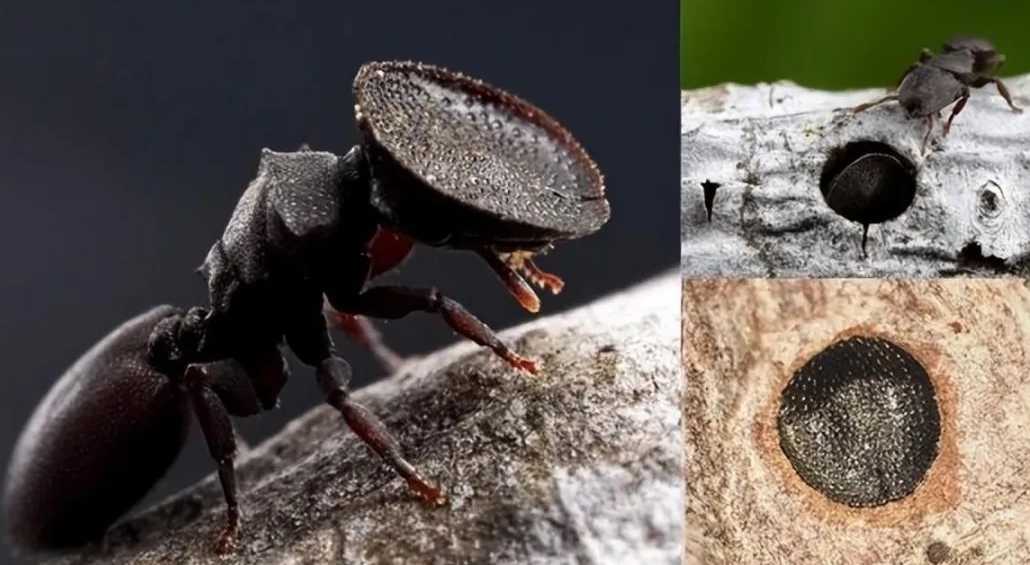
Native to the tropical forests of the Americas, the helmeted turtle ant (Cephalotes varians) is renowned for its flattened, disc - like head that resembles a natural shield. A member of the turtle ant genus, this species has evolved an extraordinary defense mechanism: when threatened, worker ants plug their nest entrances with their armored heads, acting as living barricades to fend off intruders.

Anatomy: A Head Built for Defense
  • The Natural Barricade
    The ant’s most distinctive feature is its broad, circular head, measuring up to 2 mm in diameter—precisely sized to seal the cylindrical entrances of their tree - trunk nests. The head’s rugged exoskeleton features ridges and grooves that interlock with the nest’s tunnel walls, creating a near - airtight seal.
  • Specialized Body Structure
    While workers sport enlarged heads, soldiers and queens have more typical ant anatomies. The ant’s elongated thorax and abdomen allow easy movement through narrow tunnels, while its legs are adapted for climbing, enabling quick retreats to the nest.

Defensive Behavior and Social Organization

  • Collective Nest Protection
    When predators (such as wasps or rival ant colonies) approach, turtle ants employ a coordinated defense strategy:
    1. Workers retreat into the nest tunnel tail - first.
    2. The last ant in line uses its shield - shaped head to block the entrance, with other ants bracing from behind.
    3. If needed, the ant secretes a sticky substance from its abdomen to reinforce the blockade.
  • Arboreal Colony Life
    These ants inhabit hollow tree trunks, feeding on nectar, sap, and small insects. They form medium - sized colonies with queens, workers, and soldiers, and rarely venture to the forest floor, spending most of their lives in the canopy.

Ecological Impact and Scientific Inspiration

  • Role in Forest Ecosystems
    By excavating tunnels in dead wood, turtle ants aid in forest decomposition and nutrient cycling. Their nests also provide shelter for other organisms, such as mites and beetles, that live in commensal relationships with the ants.
  • Biomimicry Applications
    Scientists study the ant’s head - plugging behavior for insights into adaptive engineering. The interlocking design of its head and nest entrance has inspired concepts for self - sealing robotic valves and emergency barrier systems.


In the rainforests of the Americas, the helmeted turtle ant exemplifies nature’s ingenuity. Its ability to transform its body into a living fortress showcases how evolution shapes both anatomy and behavior for survival—proving that even the smallest creatures hold valuable lessons in resilience and adaptive design.
Latest Stories
Feline News2 minute readThe Oriental Longhair, a breed celebrated for its elegance and intelligence, traces its roots to mid-20th-century breeding programs aimed at expanding the color and pattern diversity of Siamese cats . Developed through crosses with breeds like Russian Blues and British Shorthairs, these cats gained recognition in the 1970s and were officially acknowledged by The International Cat Association (TICA) in 1979 and the Cat Fanciers' Association (CFA) in 1995 .
Feline News2 minute readThe Korat cat, originating from Thailand’s Nakhon Ratchasima province (formerly Korat), is a breed deeply rooted in history and cultural significance. Revered for centuries as a symbol of good luck and prosperity, these silver-blue felines have enchanted the world with their striking appearance and affectionate nature.
Feline News2 minute readA heartwarming tale of survival and companionship has thrust the Munchkin cat into the global spotlight, showcasing the breed’s unique charm and indomitable spirit. Mochi, an 8-month-old Munchkin rescued from a life-threatening illness, has become an international symbol of hope, embodying the resilience and playful nature that define these short-legged felines.
Travel News2 minute readPerched atop an 82-meter volcanic plug in Le Puy-en-Velay, France, the Chapelle Saint-Michel d’Aiguilhe stands as a testament to faith and engineering prowess. Built in 962 AD, this architectural marvel balances precariously on a basaltic rock formation, blending Romanesque austerity with Moorish-inspired ornamentation to create one of Europe’s most dramatic religious landmarks.
Feline News2 minute readRagamuffin cats, affectionately known as "muffins," have captured the hearts of cat lovers worldwide with their plush coats, docile personalities, and striking appearance. Originating in the United States in the 1990s, this breed emerged from a group of breeders seeking to expand the genetic diversity of Ragdoll cats. By crossing Ragdolls with Persians, Himalayans, and other long-haired breeds, they created a larger, more robust feline with a broader range of coat colors and patterns
Canine News2 minute readOriginating in the early 20th century, the American White Shepherd traces its lineage to the German Shepherd. Due to a recessive white coat gene, these dogs were long considered "flawed" in Germany and systematically culled from breeding programs12. However, North American breeders recognized their unique appeal and selectively developed them into a distinct breed, officially acknowledged by the United Kennel Club (UKC) in 199917
Canine News1 minute readAs the world's first operational vertical/short takeoff and landing (V/STOL) fighter jet, the British-developed Harrier, nicknamed the "Jump Jet," has left an indelible mark on aviation history through its groundbreaking design and combat prowess.