The Leafy Sea Dragon: Master of Marine Camouflage from Australia’s Coastal Waters


Marine Biology
The Leafy Sea Dragon: Master of Marine Camouflage from Australia’s Coastal Waters

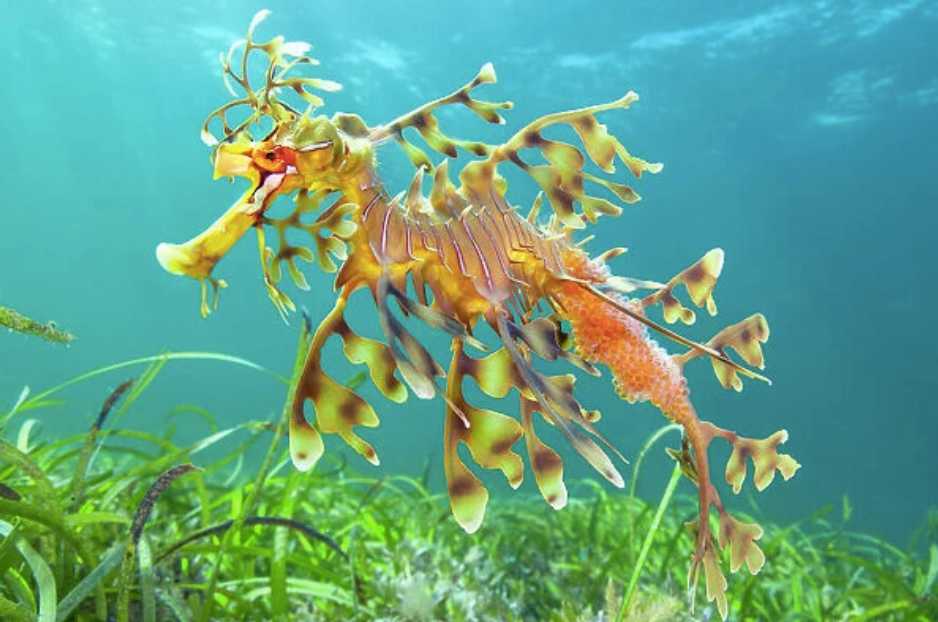
Belonging to the genus Phycodurus within the seadragon family (Syngnathidae), the leafy sea dragon is a remarkable fish adapted to life along the southern and western coasts of Australia. Recognized for its elaborate leaf-like appendages, this species has evolved one of nature’s most extraordinary camouflage strategies, blending seamlessly with oceanic vegetation.


A Floating Cluster of Seaweed: Anatomy and Adaptations

  • Leafy Projections as Natural Disguise
    The leafy sea dragon’s body is covered in thin, translucent dermal flaps that mimic kelp fronds and seaweed. These leaf-like structures, which serve no functional purpose beyond camouflage, extend from the head, trunk, and tail, creating a silhouette that drifts like floating vegetation. Its coloration—ranging from green to golden brown—further enhances the illusion, with subtle pigment changes allowing it to match surrounding algae.
  • Specialized Body for Stillness
    Unlike seahorses, which swim upright, the leafy sea dragon glides horizontally using tiny, almost invisible pectoral fins near its head and a dorsal fin along its back. This slow, undulating movement resembles the sway of seaweed in ocean currents, making it nearly indistinguishable from its habitat. Growing up to 35 centimeters, it lacks a prehensile tail, relying entirely on its camouflage for survival.

Life in Australia’s Coastal Ecosystems

  • Feeding and Behavioral Traits
    The species feeds on small crustaceans and plankton, sucking prey into its tubular snout using a vacuum-like action. It is primarily solitary, emerging from kelp forests to feed during the day and resting among vegetation at night. Males carry fertilized eggs on a spongy patch under their tails, a unique trait shared with seahorses and pipefish.
  • Habitat and Conservation Status
    Endemic to Australia, the leafy sea dragon inhabits shallow, temperate waters rich in kelp and seagrass. While listed as "Near Threatened" by the IUCN, it faces threats from habitat destruction, pollution, and accidental capture in fishing nets. Marine reserves along Australia’s coast, such as the Point Peron Marine Park, have helped protect critical habitats, while captive breeding programs in aquariums raise awareness about its conservation needs.

Cultural Significance and Scientific Wonder

The leafy sea dragon has become an iconic symbol of Australia’s marine biodiversity, featured in local art and tourism campaigns. Scientists are fascinated by its unique morphology, studying how its leafy appendages develop and whether their structure could inspire advanced camouflage technologies. As a living testament to nature’s ability to craft perfect mimicry, the species reminds humanity of the delicate balance between adaptation and environmental preservation in Earth’s oceans.
Latest Stories
Feline News2 minute readThe Oriental Longhair, a breed celebrated for its elegance and intelligence, traces its roots to mid-20th-century breeding programs aimed at expanding the color and pattern diversity of Siamese cats . Developed through crosses with breeds like Russian Blues and British Shorthairs, these cats gained recognition in the 1970s and were officially acknowledged by The International Cat Association (TICA) in 1979 and the Cat Fanciers' Association (CFA) in 1995 .
Feline News2 minute readThe Korat cat, originating from Thailand’s Nakhon Ratchasima province (formerly Korat), is a breed deeply rooted in history and cultural significance. Revered for centuries as a symbol of good luck and prosperity, these silver-blue felines have enchanted the world with their striking appearance and affectionate nature.
Feline News2 minute readA heartwarming tale of survival and companionship has thrust the Munchkin cat into the global spotlight, showcasing the breed’s unique charm and indomitable spirit. Mochi, an 8-month-old Munchkin rescued from a life-threatening illness, has become an international symbol of hope, embodying the resilience and playful nature that define these short-legged felines.
Travel News2 minute readPerched atop an 82-meter volcanic plug in Le Puy-en-Velay, France, the Chapelle Saint-Michel d’Aiguilhe stands as a testament to faith and engineering prowess. Built in 962 AD, this architectural marvel balances precariously on a basaltic rock formation, blending Romanesque austerity with Moorish-inspired ornamentation to create one of Europe’s most dramatic religious landmarks.
Feline News2 minute readRagamuffin cats, affectionately known as "muffins," have captured the hearts of cat lovers worldwide with their plush coats, docile personalities, and striking appearance. Originating in the United States in the 1990s, this breed emerged from a group of breeders seeking to expand the genetic diversity of Ragdoll cats. By crossing Ragdolls with Persians, Himalayans, and other long-haired breeds, they created a larger, more robust feline with a broader range of coat colors and patterns
Canine News2 minute readOriginating in the early 20th century, the American White Shepherd traces its lineage to the German Shepherd. Due to a recessive white coat gene, these dogs were long considered "flawed" in Germany and systematically culled from breeding programs12. However, North American breeders recognized their unique appeal and selectively developed them into a distinct breed, officially acknowledged by the United Kennel Club (UKC) in 199917
Canine News1 minute readAs the world's first operational vertical/short takeoff and landing (V/STOL) fighter jet, the British-developed Harrier, nicknamed the "Jump Jet," has left an indelible mark on aviation history through its groundbreaking design and combat prowess.