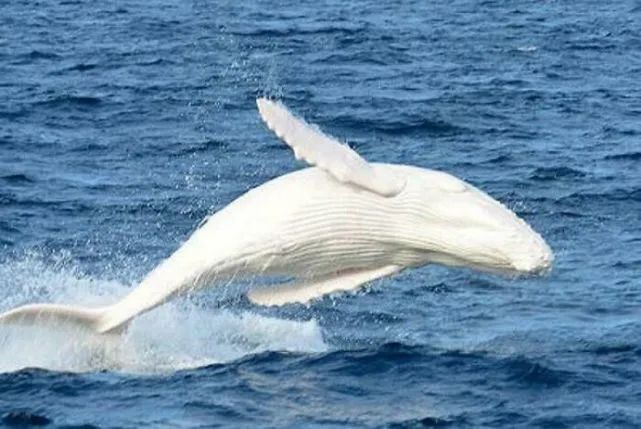
In the vast expanse of the world's oceans, few sights are as captivating and mysterious as the albino humpback whale. These rare creatures, with their ghostly white appearance, stand out starkly against the deep blue backdrop of the sea.
The Genetic Anomaly Behind Albinism
Albinism in humpback whales, as in other animals, is a result of a genetic mutation. This mutation affects the production of melanin, the pigment responsible for coloring the skin, hair, and eyes. In normal humpback whales, melanin provides the characteristic dark hues that help them blend into their marine environment to some extent. However, in albino individuals, the lack of melanin leads to their striking white coloration. Their skin, baleen plates, and even their flippers are all uniformly white, creating a breathtaking and otherworldly sight.
The Famous Migaloo: A Global Sensation
The most well - known albino humpback whale is Migaloo. First spotted in 1991 off the coast of Byron Bay, Queensland, Australia, Migaloo has captured the hearts of people around the world. Initially, it was difficult to confirm that he was an albino due to his brown eyes, as albinos typically have red or pink eyes. However, a 2011 DNA study by researchers at the Australian Marine Mammal Centre confirmed the genetic variation leading to albinism.
Migaloo is a male, which was first deduced when researchers recorded him singing in 1998. Male humpback whales are known for their complex and often beautiful songs, which they use during the mating season to attract females and establish their territory. Since his discovery, Migaloo has been sighted numerous times along the east coast of Australia during the annual humpback whale migration. He travels from the feeding grounds in Antarctica to the warmer breeding waters near the Great Barrier Reef, a journey that spans thousands of kilometers.
Challenges and Adaptations
Albino humpback whales face several challenges in the wild. Their white coloration makes them highly visible, both to potential predators, such as orcas, and to humans. This increased visibility can put them at a greater risk of being hunted or accidentally struck by ships. Additionally, their lack of melanin provides less protection against the sun's harmful ultraviolet (UV) rays. In the clear, sun - drenched waters where they often swim, this can lead to sunburn and other skin problems over time.
However, these whales also show remarkable adaptations. Their large size, with adult humpback whales reaching lengths of up to 16 meters or more, is a natural deterrent to many would - be predators. Their strong flippers and powerful tails allow them to swim efficiently, which is crucial for survival during long migrations and when avoiding threats.
Conservation Significance
The existence of albino humpback whales is not only a wonder of nature but also holds great conservation significance. As a rare genetic variation, they represent the biodiversity of the oceans. Protecting them means safeguarding the entire marine ecosystem that they are a part of. Conservation efforts focus on reducing human - related threats, such as minimizing ship strikes by implementing speed limits in whale - populated areas and reducing pollution that can harm their habitats.
In conclusion, albino humpback whales, with their unique appearance and mysterious allure, are a testament to the diversity and complexity of life in the oceans. Whether it's the famous Migaloo or other, as - yet - undiscovered albino individuals, these whales continue to fascinate scientists, nature enthusiasts, and the general public alike, reminding us of the importance of protecting our oceans and all their inhabitants.