The Panda Ant: Deceptive Black-and-White 'Ant' That's Actually a Wingless Wasp


Insect Information
The Panda Ant: Deceptive Black-and-White 'Ant' That's Actually a Wingless Wasp

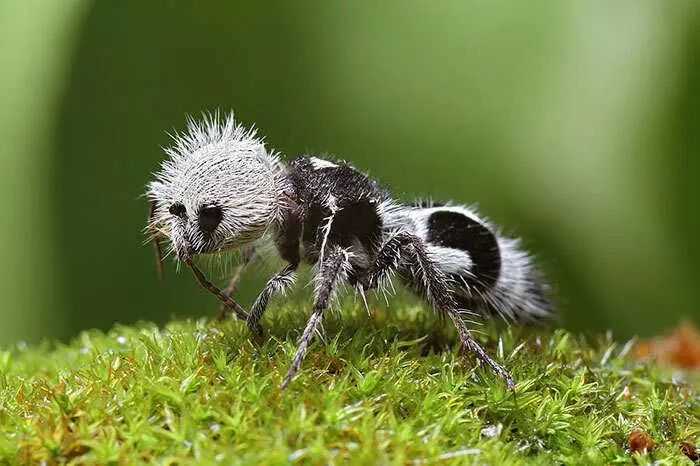
Despite its name and ant-like appearance, the panda ant (Myrmecopsis sp.) is a wingless wasp belonging to the family Mutillidae. Found in arid regions of Chile and parts of Argentina, this striking insect has captivated entomologists with its black-and-white coloration—a pattern that belies its true identity and hides a painful secret.


A Wasp in Ant's Clothing: Anatomy and Adaptations

  • Mimicry and Warning Coloration
    The panda ant’s body measures 8–10 mm, with a velvety black exoskeleton contrasted by white patches on its head, thorax, and abdomen. This bold pattern serves as aposematic coloration, warning predators of its potent sting. Females lack wings, resembling ants to blend into their environment, while males (rarely seen) have wings and a less dramatic color scheme.
  • Venomous Defense Mechanisms
    Despite its small size, the female possesses a powerful stinger, earning it the nickname "cow killer" in some regions (though its sting is not lethal to humans). The venom is designed to subdue prey and deter attackers, making it one of the most feared insects in its habitat.

Life Cycle and Ecological Role

  • Parasitic Reproductive Strategy
    Female panda ants are parasitic, laying their eggs in the nests of other ground-dwelling bees or wasps. Upon hatching, larvae feed on the host’s eggs and larvae, eventually pupating and emerging as adults. This behavior makes them important regulators of bee and wasp populations in arid ecosystems.
  • Nocturnal and Solitary Habits
    Active primarily at night, the panda ant forages for nectar and water. Its dense body hair helps it collect pollen, contributing to plant pollination despite its parasitic lifestyle. Due to its secretive nature, little is known about its mating behaviors or population dynamics.

Scientific Interest and Conservation Status

The panda ant’s unique morphology and life cycle have made it a subject of study for entomologists researching mimicry and parasitic evolution. Its presence in Chile’s arid zones also makes it an indicator of ecosystem health, though habitat destruction from agriculture and urbanization poses potential threats.


While not currently listed as endangered, the species’ reliance on specific host insects and arid habitats highlights its vulnerability to environmental changes. As with many lesser-known invertebrates, preserving the panda ant’s habitat remains crucial for maintaining biodiversity in Earth’s dryland ecosystems.


In the arid landscapes of South America, the panda ant stands as a testament to nature’s deceptive beauty. Its ant-like appearance and wasp-like biology remind us that in the insect world, looks can be profoundly misleading—and that even the most visually striking creatures may hide survival strategies as complex as they are surprising.
Latest Stories
Feline News2 minute readThe Oriental Longhair, a breed celebrated for its elegance and intelligence, traces its roots to mid-20th-century breeding programs aimed at expanding the color and pattern diversity of Siamese cats . Developed through crosses with breeds like Russian Blues and British Shorthairs, these cats gained recognition in the 1970s and were officially acknowledged by The International Cat Association (TICA) in 1979 and the Cat Fanciers' Association (CFA) in 1995 .
Feline News2 minute readThe Korat cat, originating from Thailand’s Nakhon Ratchasima province (formerly Korat), is a breed deeply rooted in history and cultural significance. Revered for centuries as a symbol of good luck and prosperity, these silver-blue felines have enchanted the world with their striking appearance and affectionate nature.
Feline News2 minute readA heartwarming tale of survival and companionship has thrust the Munchkin cat into the global spotlight, showcasing the breed’s unique charm and indomitable spirit. Mochi, an 8-month-old Munchkin rescued from a life-threatening illness, has become an international symbol of hope, embodying the resilience and playful nature that define these short-legged felines.
Travel News2 minute readPerched atop an 82-meter volcanic plug in Le Puy-en-Velay, France, the Chapelle Saint-Michel d’Aiguilhe stands as a testament to faith and engineering prowess. Built in 962 AD, this architectural marvel balances precariously on a basaltic rock formation, blending Romanesque austerity with Moorish-inspired ornamentation to create one of Europe’s most dramatic religious landmarks.
Feline News2 minute readRagamuffin cats, affectionately known as "muffins," have captured the hearts of cat lovers worldwide with their plush coats, docile personalities, and striking appearance. Originating in the United States in the 1990s, this breed emerged from a group of breeders seeking to expand the genetic diversity of Ragdoll cats. By crossing Ragdolls with Persians, Himalayans, and other long-haired breeds, they created a larger, more robust feline with a broader range of coat colors and patterns
Canine News2 minute readOriginating in the early 20th century, the American White Shepherd traces its lineage to the German Shepherd. Due to a recessive white coat gene, these dogs were long considered "flawed" in Germany and systematically culled from breeding programs12. However, North American breeders recognized their unique appeal and selectively developed them into a distinct breed, officially acknowledged by the United Kennel Club (UKC) in 199917
Canine News1 minute readAs the world's first operational vertical/short takeoff and landing (V/STOL) fighter jet, the British-developed Harrier, nicknamed the "Jump Jet," has left an indelible mark on aviation history through its groundbreaking design and combat prowess.