Satanic Leaf-Tailed Gecko: Nature's Master of Dead Leaf Mimicry


Insect Information
Satanic Leaf-Tailed Gecko: Nature's Master of Dead Leaf Mimicry

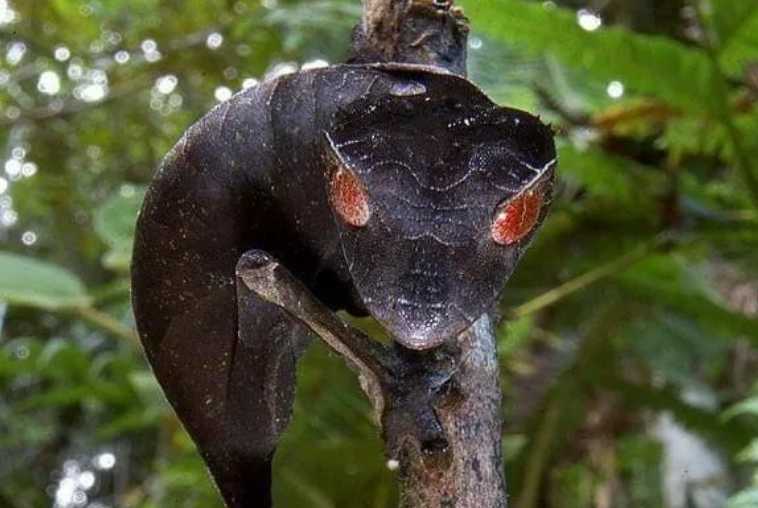
In the dense rainforests of Madagascar, a remarkable reptile demonstrates nature’s most astonishing camouflage: the Satanic leaf-tailed gecko (Uroplatus phantasticus). Renowned for its uncanny resemblance to a dried, withered leaf, this gecko has evolved the perfect disguise to vanish into its forest habitat.

The gecko’s body and tail are shaped like a curled, decaying leaf, complete with notched edges, vein-like patterns, and mottled coloration in earthy tones of brown, tan, and gray. Its tail, flattened and frayed at the tips, mimics the ragged edges of a leaf worn by time. When resting on tree branches or forest litter, it remains motionless, relying on its texture and pigmentation to blend seamlessly with dead foliage—an adaptation that wards off predators like birds and snakes. Even its skin’s texture resembles the rough surface of a dried leaf, enhancing the illusion.


Nocturnal by nature, the gecko hunts insects under the cover of night, using its camouflage to both evade predators and ambush prey. While its base color is typically brown or gray, it can subtly adjust to environmental hues, shifting to yellow, green, or orange to match surrounding vegetation. This remarkable mimicry is an evolutionary marvel: geckos with more convincing leaf-like traits survived to reproduce, refining their disguise over millennia. Today, habitat loss from deforestation and the illegal pet trade threaten these masters of mimicry, underscoring the need for conservation to protect one of nature’s most captivating living illusions.
Latest Stories
Feline News2 minute readThe Oriental Longhair, a breed celebrated for its elegance and intelligence, traces its roots to mid-20th-century breeding programs aimed at expanding the color and pattern diversity of Siamese cats . Developed through crosses with breeds like Russian Blues and British Shorthairs, these cats gained recognition in the 1970s and were officially acknowledged by The International Cat Association (TICA) in 1979 and the Cat Fanciers' Association (CFA) in 1995 .
Feline News2 minute readThe Korat cat, originating from Thailand’s Nakhon Ratchasima province (formerly Korat), is a breed deeply rooted in history and cultural significance. Revered for centuries as a symbol of good luck and prosperity, these silver-blue felines have enchanted the world with their striking appearance and affectionate nature.
Feline News2 minute readA heartwarming tale of survival and companionship has thrust the Munchkin cat into the global spotlight, showcasing the breed’s unique charm and indomitable spirit. Mochi, an 8-month-old Munchkin rescued from a life-threatening illness, has become an international symbol of hope, embodying the resilience and playful nature that define these short-legged felines.
Travel News2 minute readPerched atop an 82-meter volcanic plug in Le Puy-en-Velay, France, the Chapelle Saint-Michel d’Aiguilhe stands as a testament to faith and engineering prowess. Built in 962 AD, this architectural marvel balances precariously on a basaltic rock formation, blending Romanesque austerity with Moorish-inspired ornamentation to create one of Europe’s most dramatic religious landmarks.
Feline News2 minute readRagamuffin cats, affectionately known as "muffins," have captured the hearts of cat lovers worldwide with their plush coats, docile personalities, and striking appearance. Originating in the United States in the 1990s, this breed emerged from a group of breeders seeking to expand the genetic diversity of Ragdoll cats. By crossing Ragdolls with Persians, Himalayans, and other long-haired breeds, they created a larger, more robust feline with a broader range of coat colors and patterns
Canine News2 minute readOriginating in the early 20th century, the American White Shepherd traces its lineage to the German Shepherd. Due to a recessive white coat gene, these dogs were long considered "flawed" in Germany and systematically culled from breeding programs12. However, North American breeders recognized their unique appeal and selectively developed them into a distinct breed, officially acknowledged by the United Kennel Club (UKC) in 199917
Canine News1 minute readAs the world's first operational vertical/short takeoff and landing (V/STOL) fighter jet, the British-developed Harrier, nicknamed the "Jump Jet," has left an indelible mark on aviation history through its groundbreaking design and combat prowess.