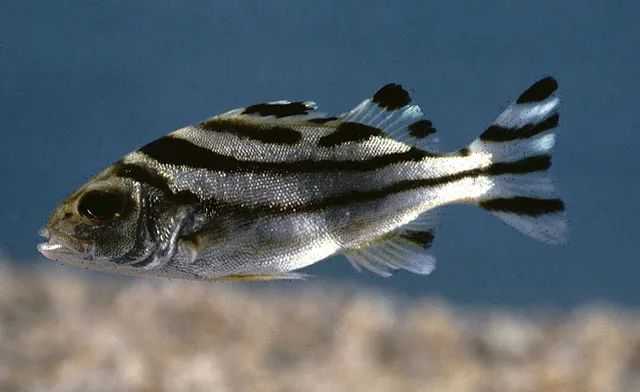
Terapon jarbua: The Crescent Grunter of Coastal Waters


Marine Biology
Terapon jarbua: The Crescent Grunter of Coastal Waters

Terapon jarbua, commonly known as the crescent grunter, is a remarkable species within the Terapontidae family. Inhabiting the warm waters of the Indo - Pacific region, this fish is celebrated for its adaptability and ecological significance in coastal and estuarine ecosystems. It showcases a unique appearance and behavioral traits that set it apart in the diverse marine world.


Growing up to 40 centimeters in length, the crescent grunter features a laterally compressed, elongated body. Its body is covered in small, 栉状 scales, giving it a sleek texture. The coloration is a blend of earthy tones, with a dorsal side that ranges from olive - brown to grayish - brown, gradually fading to a lighter, almost silvery shade on the ventral side. A defining characteristic is the presence of three prominent, curved black bands that arch along its body, creating a distinct and eye - catching pattern. The dorsal fin is divided into two parts: a spiny anterior section with XII spines and a soft - rayed posterior part with 10 rays. The anal fin has III spines and 9 - 10 soft rays. These fins, along with its forked caudal fin, enable it to navigate through various water conditions with agility.


This species is highly adaptable in terms of habitat. It can be found in a wide range of environments, from the salty expanse of the open ocean to the brackish waters of estuaries and coastal lagoons, and even penetrates well into freshwater rivers. Juveniles are often seen in intertidal zones, particularly in sandy areas and tidal pools, where they form small groups. As they grow, they become more territorial. The crescent grunter is a carnivorous predator, feeding on a diet that includes smaller fish, crustaceans like shrimp and crabs, and other benthic invertebrates such as worms and mollusks. Interestingly, it also acts as a cleaner fish on occasion, consuming ectoparasites from larger fish, and has been known to eat fish scales, which are rich in calories.


Terapon jarbua plays a crucial role in the food web of coastal ecosystems, serving as both predator and prey. It is an important commercial species within its range, targeted by various inshore fishing gears like gillnets, traps, handlines, and bottom trawls. The fish is sold fresh in local markets or processed into dried and salted forms. Additionally, it is sometimes sought after for the aquarium trade due to its unique appearance, where it is known as the "target fish" for the pattern visible from above. However, like many coastal species, it faces threats from habitat degradation, pollution, and overfishing. Conservation efforts, such as protecting estuarine and coastal habitats and implementing sustainable fishing practices, are essential to ensure the long - term survival of this fascinating crescent grunter.

Latest Stories
Travel News2 minute readNestled in the French Pre-Alps, the Plateau du Vercors stands as a testament to nature’s raw power and humanity’s indomitable spirit. Rising abruptly from the valleys of Isère, this limestone plateau—dominated by peaks like Grand Veymont (2,346 meters)—features sheer cliffs and labyrinthine gorges that earned it the nickname "the Natural Great Wall". Its dramatic landscapes, shaped over millennia by erosion, have not only sculpted a geological marvel but also forged a theater of historical significance.
Cultural News1 minute readSpain’s tomato-throwing "La Tomatina" is wildly popular, but for those who prefer hurling something tangier, head to Italy in February. At the Ivrea Carnival, thousands of ripe oranges are pelted in a juicy battle during the festival’s highlight.
Cultural News1 minute readIn Wuppertal, Germany, there’s a pedestrian bridge that looks like it’s built from giant Lego bricks. Though it’s actually a concrete structure, artists have painted it to mimic the iconic toy blocks, creating a playful optical illusion.
Feline News2 minute readThe European Burmese cat, a breed born from careful crossbreeding in mid-20th century Europe, has captivated cat enthusiasts with its elegant physique and affectionate nature. Originating from the American Burmese stock imported to the UK, European breeders sought to diversify the gene pool by introducing Siamese and British Shorthair bloodlines, resulting in a distinct feline with refined features. Recognized by major associations like the CFA since 2002, this breed stands out for its sleek, muscular build and striking golden or amber almond-shaped eyes, which contrast sharply with the rounde
Feline News2 minute readIn recent years, the Scottish Fold cat has become an internet sensation, celebrated for its distinctive folded ears and owl-like appearance. However, behind the adorable facade lies a dark reality rooted in genetic abnormality and ethical debate. This breed, born from a spontaneous mutation in a Scottish barn cat named Susie in 1961, has sparked global controversy over its health implications and breeding practices.
Feline News1 minute readOriginating from a spontaneous genetic mutation in 1950, the Cornish Rex emerged in Cornwall, England, when a cream-colored kitten named Kallibunker was born with a dense, wavy coat resembling a lamb’s fleece1. Recognizing its uniqueness, owner Nina Ennismore collaborated with geneticists to establish the breed. Due to the recessive nature of the mutation, breeding two Cornish Rex cats guarantees curly-coated offspring13.
Health News1 minute readOn June 30, FBI Deputy Director Dan Bongino announced the dismantling of the largest healthcare fraud case in U.S. history, with revised to $14.6 billion. The investigation covered all 50 federal districts, indicting 324 individuals—including 96 medical practitioners—and seizing $245 million in assets.