The Majestic King Protea: South Africa's Floral Crown Jewel


Plant Information
The Majestic King Protea: South Africa's Floral Crown Jewel

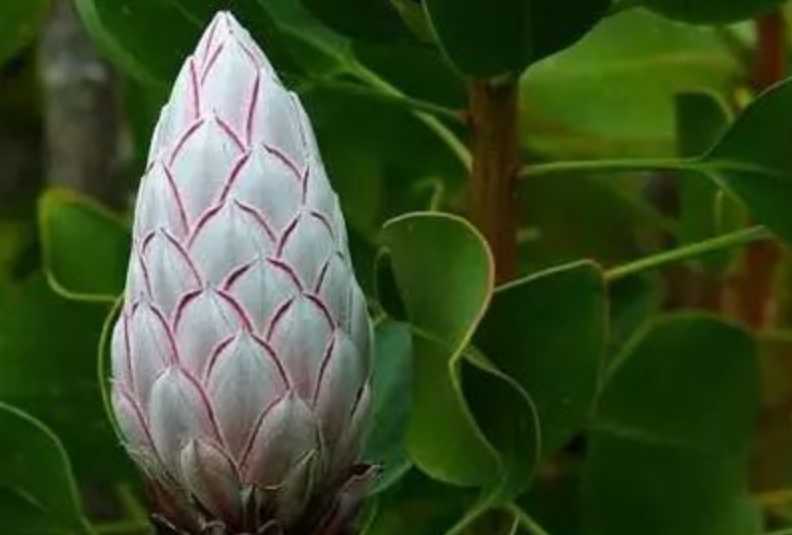
The King Protea (Protea cynaroides), an iconic flower native to South Africa, stands as a symbol of the nation's rich biodiversity and natural splendor. This remarkable plant has captured the hearts of people worldwide with its unique appearance and cultural significance.

As the largest flower in the Protea genus, the King Protea is truly a sight to behold. Its large, showy flower heads can reach up to 30 centimeters in diameter, presenting a captivating display. The flower heads are composed of numerous small flowers grouped together, surrounded by colorful, leathery bracts that range in color from deep pink to creamy white. These bracts not only add to the flower's visual allure but also protect the delicate inner flowers. The overall shape of the King Protea, with its rounded form and prominent central disk, resembles a regal crown, which is fitting for a flower that has earned the title of South Africa's national flower since 1976.


The King Protea thrives in the southwestern and southern parts of South Africa, particularly in the fynbos region. This shrub can grow up to 2 meters tall, featuring a sturdy stem and elliptical, glossy leaves. It has adapted well to the region's arid and Mediterranean - like climate. Its tough, waxy leaves help reduce water loss, and its deep - rooted system allows it to access water from deeper soil layers. In the wild, it often blooms from late winter to early summer, attracting a variety of pollinators, especially sunbirds. These birds, with their long, curved beaks, are well - equipped to reach the nectar hidden within the flower, and in the process, they play a crucial role in the plant's reproduction.


Beyond its natural beauty, the King Protea holds great cultural value. It is widely used in floral arrangements and is highly sought after in the international cut - flower market due to its long vase life, often lasting 10 - 20 days. In South African culture, it represents courage and is a source of national pride. Moreover, the flower has inspired various art forms, from paintings to sculptures. As an evergreen shrub, it also plays an important ecological role in its native habitat, providing food and shelter for local wildlife. Whether admired in a garden or a bouquet, the King Protea continues to enchant with its grandeur and unique charm.

Latest Stories
Feline News2 minute readThe Oriental Longhair, a breed celebrated for its elegance and intelligence, traces its roots to mid-20th-century breeding programs aimed at expanding the color and pattern diversity of Siamese cats . Developed through crosses with breeds like Russian Blues and British Shorthairs, these cats gained recognition in the 1970s and were officially acknowledged by The International Cat Association (TICA) in 1979 and the Cat Fanciers' Association (CFA) in 1995 .
Feline News2 minute readThe Korat cat, originating from Thailand’s Nakhon Ratchasima province (formerly Korat), is a breed deeply rooted in history and cultural significance. Revered for centuries as a symbol of good luck and prosperity, these silver-blue felines have enchanted the world with their striking appearance and affectionate nature.
Feline News2 minute readA heartwarming tale of survival and companionship has thrust the Munchkin cat into the global spotlight, showcasing the breed’s unique charm and indomitable spirit. Mochi, an 8-month-old Munchkin rescued from a life-threatening illness, has become an international symbol of hope, embodying the resilience and playful nature that define these short-legged felines.
Travel News2 minute readPerched atop an 82-meter volcanic plug in Le Puy-en-Velay, France, the Chapelle Saint-Michel d’Aiguilhe stands as a testament to faith and engineering prowess. Built in 962 AD, this architectural marvel balances precariously on a basaltic rock formation, blending Romanesque austerity with Moorish-inspired ornamentation to create one of Europe’s most dramatic religious landmarks.
Feline News2 minute readRagamuffin cats, affectionately known as "muffins," have captured the hearts of cat lovers worldwide with their plush coats, docile personalities, and striking appearance. Originating in the United States in the 1990s, this breed emerged from a group of breeders seeking to expand the genetic diversity of Ragdoll cats. By crossing Ragdolls with Persians, Himalayans, and other long-haired breeds, they created a larger, more robust feline with a broader range of coat colors and patterns
Canine News2 minute readOriginating in the early 20th century, the American White Shepherd traces its lineage to the German Shepherd. Due to a recessive white coat gene, these dogs were long considered "flawed" in Germany and systematically culled from breeding programs12. However, North American breeders recognized their unique appeal and selectively developed them into a distinct breed, officially acknowledged by the United Kennel Club (UKC) in 199917
Canine News1 minute readAs the world's first operational vertical/short takeoff and landing (V/STOL) fighter jet, the British-developed Harrier, nicknamed the "Jump Jet," has left an indelible mark on aviation history through its groundbreaking design and combat prowess.