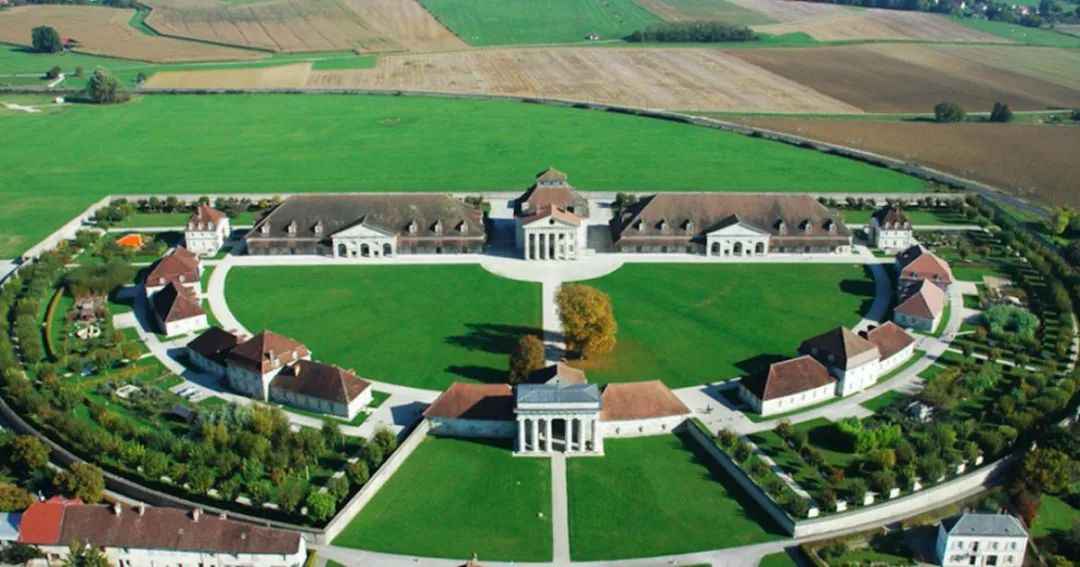
Nestled in the Jura region near Besançon, France, a semicircular complex stands silently, bearing witness to the brilliance of 18th-century industrial revolution and the practice of Enlightenment ideals—the Royal Saltworks of Arc-et-Senans (Saline royale d'Arc-et-Senans), inscribed as a UNESCO World Heritage Site in 1982. Designed by the visionary architect Claude-Nicolas Ledoux, this saltworks was commissioned during the reign of Louis XVI in 1775 and completed four years later, marking Europe’s first industrial complex integrating production, residence, and social aspirations.
Nestled in the Jura region near Besançon, France, a semicircular complex stands silently, bearing witness to the brilliance of 18th-century industrial revolution and the practice of Enlightenment ideals—the Royal Saltworks of Arc-et-Senans (Saline royale d'Arc-et-Senans), inscribed as a UNESCO World Heritage Site in 1982. Designed by the visionary architect Claude-Nicolas Ledoux, this saltworks was commissioned during the reign of Louis XVI in 1775 and completed four years later, marking Europe’s first industrial complex integrating production, residence, and social aspirations.
The saltworks emerged from the French monarchy’s need to monopolize the salt tax (Gabelle). In the 18th century, salt was not only a necessity for food preservation but also underpinned industries like glassmaking, agriculture, and medicine, with its tax revenues forming a significant portion of state finances. Ledoux’s design broke with tradition: 11 buildings—including workers’ dormitories, administrative offices, and stables—were arranged in a perfect semicircle around a central superintendent’s mansion, symbolizing "the harmonious unity of reason and hierarchical order." This layout optimized production processes: brine was transported 21 kilometers via wooden pipelines (Saumoduc) from the Salins-les-Bains salt mines, crystallizing into salt through natural evaporation and wood-fired heating. Beyond functionality, the design embodied Enlightenment thinkers’ vision of an "ideal society": workers and managers collaborated within the same space, while the symmetry and geometric aesthetics of the architecture sought to foster collective virtue and happiness.
The saltworks ceased operations in 1895 due to technological advancements, later enduring fires, looting, and stone theft, teetering on the brink of destruction. In 1927, the Doubs department government acquired the site, launching three restoration projects over 60 years, finally restoring it to its original glory in 1996. Today, the 13-hectare complex has been transformed into a cultural hub, attracting 120,000 visitors annually. Alongside permanent exhibitions showcasing salt’s history and industrial processes, the site hosts international concerts, contemporary art exhibitions, and virtual reality tours that let visitors "time-travel" to experience 18th-century saltworkers’ daily lives. In 2025, marking the "Year of World Heritage," the saltworks will feature light shows, garden festivals, and an immersive experience inspired by cartoonist Hugo Pratt’s works.
In his later years, Ledoux envisioned expanding the saltworks into an "ideal city" (Cité idéale de Chaux), a plan thwarted by the French Revolution. In 2019, the saltworks launched the "Un Cercle Immense" (An Immense Circle) project, creating an ecological education park on 19 hectares of northern grasslands. Designed by renowned French landscape architects, the park showcases the Jura’s biodiversity through wetlands and forests while preserving the radial road blueprint conceived by Ledoux. Slated to open in 2023, the project merges historical heritage with sustainable development, continuing the Enlightenment’s social ideals.
This temple of "white gold" stands as both a testament to 18th-century industrial civilization and a laboratory for contemporary cultural innovation. As UNESCO noted, the Royal Saltworks of Arc-et-Senans is not merely a milestone in architectural history but "materially embodies the Enlightenment's pursuit of reason, progress, and social harmony."