Apogon kiensis: The Pendant-Banded Cardinalfish of Tropical Reefs


Marine Biology
Apogon kiensis: The Pendant-Banded Cardinalfish of Tropical Reefs

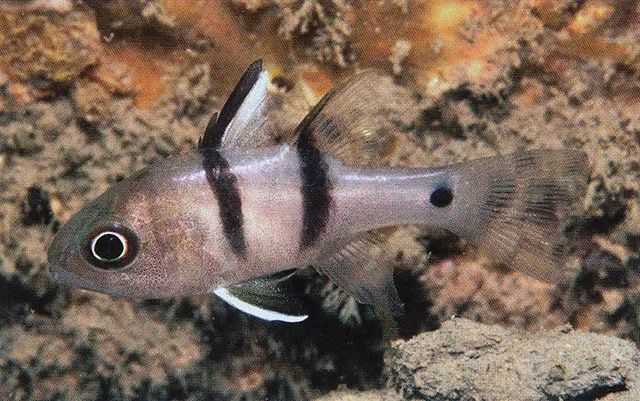
Apogon kiensis, commonly known as the pendant-banded cardinalfish, is a small, captivating species belonging to the Apogonidae family, inhabiting the warm, clear waters of the Indo-Pacific region. Named for the distinct vertical bands on its body, this fish features a streamlined, oval-shaped body with a rich reddish-brown to orange coloration, accented by two prominent dark vertical bands—one just behind the gills and another near the caudal fin—giving it a striking and recognizable appearance.


Growing up to 8 centimeters in length, the pendant-banded cardinalfish is characterized by large, round eyes adapted for low-light activity, a trait common among nocturnal reef dwellers. Its dorsal fin is divided into two distinct parts: the first with sharp spines for defense, and the second with soft rays for maneuverability. By day, it seeks shelter in coral crevices, rocky outcrops, or among the protective fronds of sea fans and gorgonians, emerging at night to feed on zooplankton, small crustaceans, and tiny invertebrates. This species often forms small groups or pairs, relying on its cryptic coloration to avoid detection by larger predators such as groupers and barracudas.


Distributed from the Red Sea and East Africa to the waters of Japan, Indonesia, and Australia, Apogon kiensis plays a crucial role in reef ecosystems as a mesopredator, regulating populations of small invertebrates while serving as a food source for larger fish. While not commercially fished for human consumption, it is occasionally collected for the aquarium trade, appreciated for its vibrant colors and peaceful nature in reef tanks. However, it faces significant threats from coral reef degradation, driven by climate change, pollution, and destructive fishing practices. The loss of coral habitats reduces available shelter and food sources, impacting both juveniles and adults. Conservation initiatives, including the establishment of marine protected areas and sustainable reef management, are essential to safeguard this species and the fragile ecosystems it inhabits. As a symbol of the intricate web of life in tropical reefs, Apogon kiensis underscores the urgent need to protect these biodiverse environments for future generations.

Latest Stories
Feline News2 minute readThe Oriental Longhair, a breed celebrated for its elegance and intelligence, traces its roots to mid-20th-century breeding programs aimed at expanding the color and pattern diversity of Siamese cats . Developed through crosses with breeds like Russian Blues and British Shorthairs, these cats gained recognition in the 1970s and were officially acknowledged by The International Cat Association (TICA) in 1979 and the Cat Fanciers' Association (CFA) in 1995 .
Feline News2 minute readThe Korat cat, originating from Thailand’s Nakhon Ratchasima province (formerly Korat), is a breed deeply rooted in history and cultural significance. Revered for centuries as a symbol of good luck and prosperity, these silver-blue felines have enchanted the world with their striking appearance and affectionate nature.
Feline News2 minute readA heartwarming tale of survival and companionship has thrust the Munchkin cat into the global spotlight, showcasing the breed’s unique charm and indomitable spirit. Mochi, an 8-month-old Munchkin rescued from a life-threatening illness, has become an international symbol of hope, embodying the resilience and playful nature that define these short-legged felines.
Travel News2 minute readPerched atop an 82-meter volcanic plug in Le Puy-en-Velay, France, the Chapelle Saint-Michel d’Aiguilhe stands as a testament to faith and engineering prowess. Built in 962 AD, this architectural marvel balances precariously on a basaltic rock formation, blending Romanesque austerity with Moorish-inspired ornamentation to create one of Europe’s most dramatic religious landmarks.
Feline News2 minute readRagamuffin cats, affectionately known as "muffins," have captured the hearts of cat lovers worldwide with their plush coats, docile personalities, and striking appearance. Originating in the United States in the 1990s, this breed emerged from a group of breeders seeking to expand the genetic diversity of Ragdoll cats. By crossing Ragdolls with Persians, Himalayans, and other long-haired breeds, they created a larger, more robust feline with a broader range of coat colors and patterns
Canine News2 minute readOriginating in the early 20th century, the American White Shepherd traces its lineage to the German Shepherd. Due to a recessive white coat gene, these dogs were long considered "flawed" in Germany and systematically culled from breeding programs12. However, North American breeders recognized their unique appeal and selectively developed them into a distinct breed, officially acknowledged by the United Kennel Club (UKC) in 199917
Canine News1 minute readAs the world's first operational vertical/short takeoff and landing (V/STOL) fighter jet, the British-developed Harrier, nicknamed the "Jump Jet," has left an indelible mark on aviation history through its groundbreaking design and combat prowess.