Mushrooms That Glow at Night: A Mysterious and Beautiful Natural Phenomenon


Insect Information
Mushrooms That Glow at Night: A Mysterious and Beautiful Natural Phenomenon

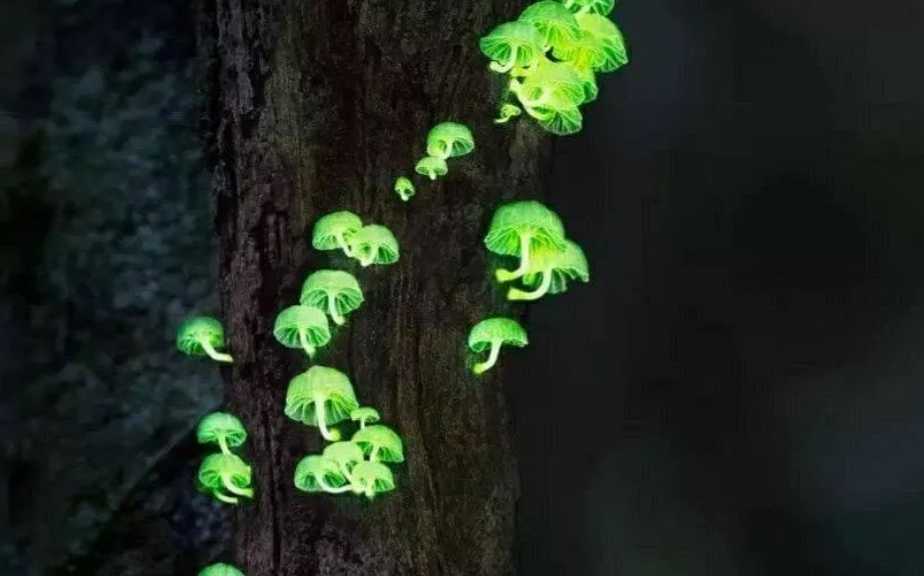
In the mysterious world of fungi, there exists a group of mushrooms with a unique ability - they can glow in the dark, creating a captivating and otherworldly scene.


These bioluminescent mushrooms produce light through a chemical reaction involving luciferin and luciferase1. When these substances come into contact with oxygen, light is emitted. The light is usually green and has a wavelength between 520 - 530 nm. There are many types of glowing mushrooms. For example, Panellus stipticus is one of the brightest. It is a flat - shaped fungus that looks like a pile of small fans growing on a stick. It is dull beige during the day, but at night it becomes extremely dazzling2Mycena chlorophos is also well - known. Its cap is yellow - green, and when it opens, it emits a pale - green glow1. In addition, Armillaria mellea is one of the most widely distributed luminescent fungi, found in North America and Asia. Both its fruiting body and mycelium can glow2.


The exact purpose of the bioluminescence in mushrooms is still uncertain1. Some scientists believe that it may serve as a way to attract insects, which would then help to spread the spores of the fungus to new areas1. Others believe that it may be a form of defense, deterring predators from consuming the mushroom by making it less appealing1.
Latest Stories
Travel News2 minute readNestled in the French Pre-Alps, the Plateau du Vercors stands as a testament to nature’s raw power and humanity’s indomitable spirit. Rising abruptly from the valleys of Isère, this limestone plateau—dominated by peaks like Grand Veymont (2,346 meters)—features sheer cliffs and labyrinthine gorges that earned it the nickname "the Natural Great Wall". Its dramatic landscapes, shaped over millennia by erosion, have not only sculpted a geological marvel but also forged a theater of historical significance.
Cultural News1 minute readSpain’s tomato-throwing "La Tomatina" is wildly popular, but for those who prefer hurling something tangier, head to Italy in February. At the Ivrea Carnival, thousands of ripe oranges are pelted in a juicy battle during the festival’s highlight.
Cultural News1 minute readIn Wuppertal, Germany, there’s a pedestrian bridge that looks like it’s built from giant Lego bricks. Though it’s actually a concrete structure, artists have painted it to mimic the iconic toy blocks, creating a playful optical illusion.
Feline News2 minute readThe European Burmese cat, a breed born from careful crossbreeding in mid-20th century Europe, has captivated cat enthusiasts with its elegant physique and affectionate nature. Originating from the American Burmese stock imported to the UK, European breeders sought to diversify the gene pool by introducing Siamese and British Shorthair bloodlines, resulting in a distinct feline with refined features. Recognized by major associations like the CFA since 2002, this breed stands out for its sleek, muscular build and striking golden or amber almond-shaped eyes, which contrast sharply with the rounde
Feline News2 minute readIn recent years, the Scottish Fold cat has become an internet sensation, celebrated for its distinctive folded ears and owl-like appearance. However, behind the adorable facade lies a dark reality rooted in genetic abnormality and ethical debate. This breed, born from a spontaneous mutation in a Scottish barn cat named Susie in 1961, has sparked global controversy over its health implications and breeding practices.
Feline News1 minute readOriginating from a spontaneous genetic mutation in 1950, the Cornish Rex emerged in Cornwall, England, when a cream-colored kitten named Kallibunker was born with a dense, wavy coat resembling a lamb’s fleece1. Recognizing its uniqueness, owner Nina Ennismore collaborated with geneticists to establish the breed. Due to the recessive nature of the mutation, breeding two Cornish Rex cats guarantees curly-coated offspring13.
Health News1 minute readOn June 30, FBI Deputy Director Dan Bongino announced the dismantling of the largest healthcare fraud case in U.S. history, with revised to $14.6 billion. The investigation covered all 50 federal districts, indicting 324 individuals—including 96 medical practitioners—and seizing $245 million in assets.