The Bobbit Worm: Nature’s Terrifying Underwater Predator Straight Out of a Sci-Fi Movie


Marine Biology
The Bobbit Worm: Nature’s Terrifying Underwater Predator Straight Out of a Sci-Fi Movie

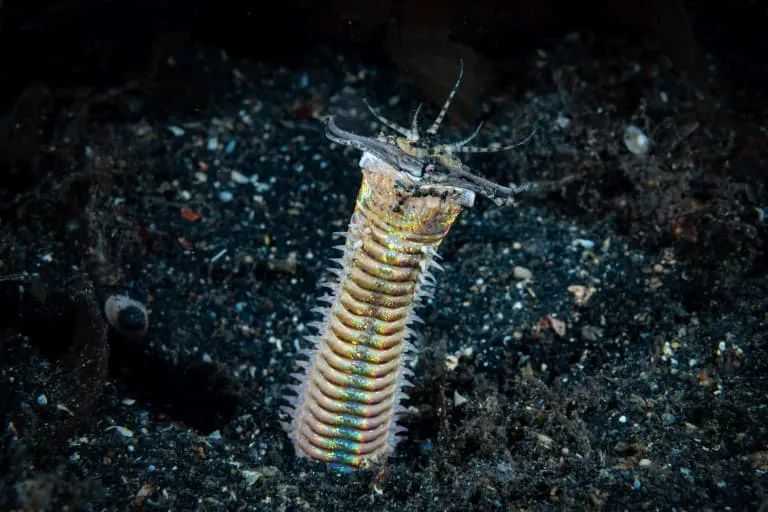
Often described as the stuff of nightmares, the Bobbit worm (Eunice aphroditois) is a marine polychaete worm that has earned its reputation as one of the ocean’s most otherworldly creatures. With a body that can stretch up to 3 meters in length, this subterranean predator lurks in tropical and subtropical seafloors, blending scientific fascination with sheer terror.

The Bobbit Worm: Nature’s Terrifying Underwater Predator Straight Out of a Sci-Fi Movie


Often described as the stuff of nightmares, the Bobbit worm (Eunice aphroditois) is a marine polychaete worm that has earned its reputation as one of the ocean’s most otherworldly creatures. With a body that can stretch up to 3 meters in length, this subterranean predator lurks in tropical and subtropical seafloors, blending scientific fascination with sheer terror.
Source: Images from the Internet, if there is any infringement, please contact the removal of


Anatomy of a Nightmarish Hunter

  • Hide-and-Strike Specialization
    The Bobbit worm spends most of its life burrowed in sand or coral rubble, leaving only its five antennae (used to detect movement) and a set of razor-sharp, pincer-like jaws exposed. When prey—fish, crustaceans, or even other worms—swims past, it launches a lightning-fast attack, slicing through victims with its mandibles. Its name nods to the infamous Lorena Bobbitt case, referencing the worm’s ability to "dismember" prey in an instant.
  • Regenerative Powers
    Even if half its body is lost, the Bobbit worm can regenerate, a trait common in polychaetes but no less astonishing in such a massive creature. Its cylindrical body is segmented, each section containing vital organs, allowing it to survive severe damage.

Life in the Depths: Behavior and Adaptations

  • Ambush Predation at Its Finest
    With poor eyesight, the worm relies on chemoreceptors and tactile sensors to locate food. Its burrow can be lined with a mucus secretion to stabilize the walls, and some individuals even decorate the entrance with shells or debris for camouflage. At night, it may extend further from its burrow to hunt, using its powerful muscles to drag prey underground.
  • Global Distribution, Silent Terror
    Found in warm oceans worldwide, from the Indian Ocean to the Caribbean, the Bobbit worm often goes unnoticed until it’s accidentally uncovered by divers or fishermen. Its sheer size—rarely seen in worms—has fueled comparisons to extraterrestrial beings, especially when videos show it ambushing unsuspecting fish.

Scientific Wonder and Human Encounters

While rarely a threat to humans (unless provoked), the Bobbit worm has become a viral sensation, with aquarium owners occasionally discovering them hiding in live rock, where they can grow undetected for years. Researchers study their neural and muscular systems to understand how such a simple organism can achieve such precise, violent attacks.


In the ocean’s silent depths, the Bobbit worm stands as a reminder that nature’s most fearsome predators often wear the most unexpected forms. Its alien-like appearance and brutal hunting tactics may spark horror, but they also reveal the incredible diversity of life strategies in Earth’s last frontiers—proving that sometimes, truth is stranger (and scarier) than fiction.
Latest Stories
Feline News2 minute readThe Oriental Longhair, a breed celebrated for its elegance and intelligence, traces its roots to mid-20th-century breeding programs aimed at expanding the color and pattern diversity of Siamese cats . Developed through crosses with breeds like Russian Blues and British Shorthairs, these cats gained recognition in the 1970s and were officially acknowledged by The International Cat Association (TICA) in 1979 and the Cat Fanciers' Association (CFA) in 1995 .
Feline News2 minute readThe Korat cat, originating from Thailand’s Nakhon Ratchasima province (formerly Korat), is a breed deeply rooted in history and cultural significance. Revered for centuries as a symbol of good luck and prosperity, these silver-blue felines have enchanted the world with their striking appearance and affectionate nature.
Feline News2 minute readA heartwarming tale of survival and companionship has thrust the Munchkin cat into the global spotlight, showcasing the breed’s unique charm and indomitable spirit. Mochi, an 8-month-old Munchkin rescued from a life-threatening illness, has become an international symbol of hope, embodying the resilience and playful nature that define these short-legged felines.
Travel News2 minute readPerched atop an 82-meter volcanic plug in Le Puy-en-Velay, France, the Chapelle Saint-Michel d’Aiguilhe stands as a testament to faith and engineering prowess. Built in 962 AD, this architectural marvel balances precariously on a basaltic rock formation, blending Romanesque austerity with Moorish-inspired ornamentation to create one of Europe’s most dramatic religious landmarks.
Feline News2 minute readRagamuffin cats, affectionately known as "muffins," have captured the hearts of cat lovers worldwide with their plush coats, docile personalities, and striking appearance. Originating in the United States in the 1990s, this breed emerged from a group of breeders seeking to expand the genetic diversity of Ragdoll cats. By crossing Ragdolls with Persians, Himalayans, and other long-haired breeds, they created a larger, more robust feline with a broader range of coat colors and patterns
Canine News2 minute readOriginating in the early 20th century, the American White Shepherd traces its lineage to the German Shepherd. Due to a recessive white coat gene, these dogs were long considered "flawed" in Germany and systematically culled from breeding programs12. However, North American breeders recognized their unique appeal and selectively developed them into a distinct breed, officially acknowledged by the United Kennel Club (UKC) in 199917
Canine News1 minute readAs the world's first operational vertical/short takeoff and landing (V/STOL) fighter jet, the British-developed Harrier, nicknamed the "Jump Jet," has left an indelible mark on aviation history through its groundbreaking design and combat prowess.