The Jewel Beetles (Buprestidae): Nature's Iridescent Gems


Insect Information
The Jewel Beetles (Buprestidae): Nature's Iridescent Gems

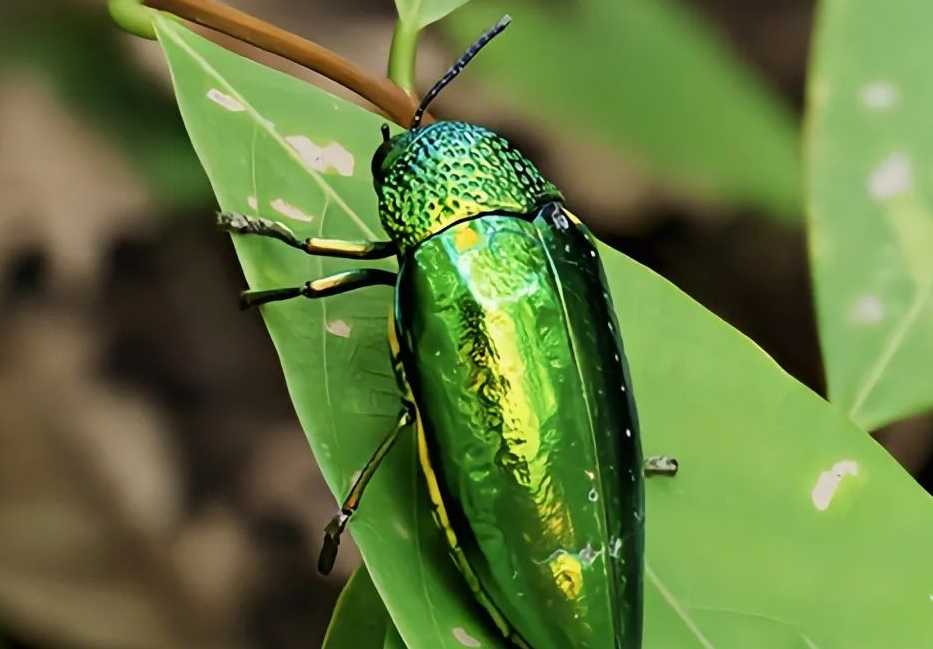
Jewel beetles, members of the family Buprestidae, are renowned for their exoskeletons that shimmer with metallic hues resembling emeralds, sapphires, and gold. This optical marvel arises from structural coloration—microscopic layers on their elytra that refract light, creating vibrant, fade - resistant iridescence. Found across Asia, Africa, and the Americas, these beetles have captivated humans for millennia with their gem - like appearance.


The Science of Structural Color
Unlike pigments, which fade over time, the beetles’ colors stem from nano - scale ridges and layers on their elytra. These structures interfere with light waves, producing hues that shift with viewing angles. For example, species like Chrysochroa fulgidissima display vivid green or blue sheens, while others may appear copper or purple. This adaptation serves dual purposes: camouflage among sunlit foliage and visual signaling during mating. The durability of these colors—remaining vibrant even after the beetle’s death—has made them prized materials for decorative arts.


Cultural Significance and Artistic Use
In Asia, jewel beetle elytra have been used in traditional crafts for centuries. Japanese * tamamono * (decorative art) and Thai * lai ruam mit * embroidery incorporate these iridescent scales to create elaborate patterns. In Myanmar and India, they adorn headdresses, jewelry, and religious artifacts, symbolizing wealth and prosperity. The beetles’ resistance to fading made them valuable substitutes for precious gems in pre - industrial societies. Even today, their wings inspire contemporary fashion and jewelry designs, blending nature’s artistry with human creativity.


Ecological Roles and Modern Research
In ecosystems, jewel beetles play vital roles as pollinators and decomposers. Larvae bore into trees, aiding in wood decay and nutrient cycling, while adults feed on nectar and foliage. Their structural coloration has also become a focus of scientific study: researchers analyze the nano - architecture of their exoskeletons to develop sustainable iridescent materials, energy - efficient optical devices, and even anti - counterfeiting technologies. By mimicking the beetles’ light - manipulating structures, scientists hope to create eco - friendly alternatives to synthetic dyes and pigments.


From ancient adornments to cutting - edge biomimicry, jewel beetles exemplify the intersection of natural beauty and human ingenuity. Their iridescent wings, a product of millions of years of evolution, serve as both a reminder of Earth’s biodiversity and a source of inspiration for sustainable innovation. As we continue to unlock the secrets of their "optical code," these living gems remind us of the infinite wonders hidden in the insect world.
Latest Stories
Feline News2 minute readThe Oriental Longhair, a breed celebrated for its elegance and intelligence, traces its roots to mid-20th-century breeding programs aimed at expanding the color and pattern diversity of Siamese cats . Developed through crosses with breeds like Russian Blues and British Shorthairs, these cats gained recognition in the 1970s and were officially acknowledged by The International Cat Association (TICA) in 1979 and the Cat Fanciers' Association (CFA) in 1995 .
Feline News2 minute readThe Korat cat, originating from Thailand’s Nakhon Ratchasima province (formerly Korat), is a breed deeply rooted in history and cultural significance. Revered for centuries as a symbol of good luck and prosperity, these silver-blue felines have enchanted the world with their striking appearance and affectionate nature.
Feline News2 minute readA heartwarming tale of survival and companionship has thrust the Munchkin cat into the global spotlight, showcasing the breed’s unique charm and indomitable spirit. Mochi, an 8-month-old Munchkin rescued from a life-threatening illness, has become an international symbol of hope, embodying the resilience and playful nature that define these short-legged felines.
Travel News2 minute readPerched atop an 82-meter volcanic plug in Le Puy-en-Velay, France, the Chapelle Saint-Michel d’Aiguilhe stands as a testament to faith and engineering prowess. Built in 962 AD, this architectural marvel balances precariously on a basaltic rock formation, blending Romanesque austerity with Moorish-inspired ornamentation to create one of Europe’s most dramatic religious landmarks.
Feline News2 minute readRagamuffin cats, affectionately known as "muffins," have captured the hearts of cat lovers worldwide with their plush coats, docile personalities, and striking appearance. Originating in the United States in the 1990s, this breed emerged from a group of breeders seeking to expand the genetic diversity of Ragdoll cats. By crossing Ragdolls with Persians, Himalayans, and other long-haired breeds, they created a larger, more robust feline with a broader range of coat colors and patterns
Canine News2 minute readOriginating in the early 20th century, the American White Shepherd traces its lineage to the German Shepherd. Due to a recessive white coat gene, these dogs were long considered "flawed" in Germany and systematically culled from breeding programs12. However, North American breeders recognized their unique appeal and selectively developed them into a distinct breed, officially acknowledged by the United Kennel Club (UKC) in 199917
Canine News1 minute readAs the world's first operational vertical/short takeoff and landing (V/STOL) fighter jet, the British-developed Harrier, nicknamed the "Jump Jet," has left an indelible mark on aviation history through its groundbreaking design and combat prowess.